AI estimate as of August 28, 2025 · verify with a professional before acting
AI-Generated · Verify before acting
Everything on this page is generated by AI for informational purposes only. AI can make mistakes — the AI may misidentify items or misattribute them (artist, maker, brand, designer, origin, era). This is not an official valuation and should not be used for insurance, sale, tax, estate, legal, or lending purposes — or any decision requiring a certified appraisal. It is not an authoritative claim about any person, brand, or rights holder — do not share or rely on it as a factual statement about a third party. Always consult qualified professionals before making financial decisions.
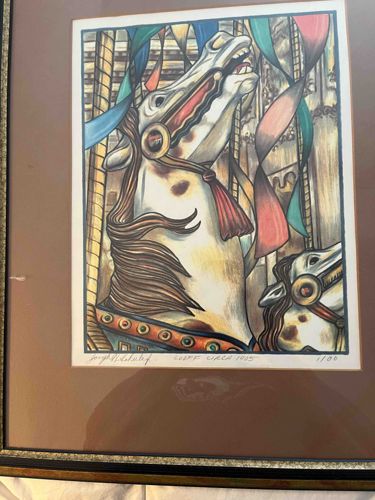
This item is a framed limited edition art print, likely a serigraph or lithograph, depicting a detailed and vibrant carousel horse with another horse's head visible in the lower right. The primary carousel horse is shown from the chest up, with its head reared back in a dynamic posture, mouth open, and bridle visible. Its coat is predominantly white with brown dapple markings, and its mane is rendered in rich brown tones. Decorative elements on the bridle and harness feature gold-colored rings and a red tassel. The background suggests the ornate structure of a carousel, complete with vertical poles and colorful pennants or ribbons in shades of blue, green, and red, adding depth and movement to the composition. The print is housed within a brown matte board, which provides a stark contrast to the artwork and enhances its visual impact, and is enclosed by a dark, possibly wooden, frame with intricate gold-toned detailing along the inner edge. Visible inscriptions at the bottom left of the print include what appears to be a signature, "Joseph G. Schelfaut," followed by "SCOFF CIRCA 1985," indicating the artist and the approximate creation date. In the bottom right corner, "1/100" is visible, signifying that this is the first print in a limited edition run of one hundred. The print appears to be in good condition, with no overt signs of significant wear, fading, or damage, though minor dust or reflections are visible on the glass due to the photographic angle. The craftsmanship of the print suggests a high-quality reproduction method, preserving the intricate lines and color gradients of the original artwork. The framing also appears to be professionally done, indicating care in its presentation and preservation.
AI Appraisal Report
I have examined the provided image of the Joseph G. Schelfaut Limited Edition Print: Carousel Horse. Based on this visual inspection, the print appears to be in very good condition. There are no obvious signs of abrasions, significant color fade, or damage to the print itself. The framing also appears professional, enhancing its presentation and protection. The visible signature 'Joseph G. Schelfaut' and 'SCOFF CIRCA 1985,' along with the '1/100' edition number, strongly suggest authenticity as a limited-edition piece from that period.
Market conditions for works by Joseph G. Schelfaut, particularly his carousel horse series, show a consistent, albeit niche, demand. These prints are appreciated for their whimsical yet detailed artistry and are popular among collectors of equestrian art, carousel enthusiasts, and those seeking decorative art from the mid-1980s. The '1/100' indicates a very low print number within a relatively small edition, which can slightly increase its desirability among collectors who value initial impressions. However, being the first print in an edition does not necessarily equate to a highly significant value premium unless there is specific documented provenance or an artist's personal annotations that justify it.
Factors impacting value include the artist's established secondary market, the visual appeal of this specific composition, and its excellent apparent condition. The professional framing also adds to its immediate display value. The primary limitation to this appraisal is the lack of physical examination. A hands-on inspection would allow for definitive authentication of the signature, assessment of the substrate, verification of the printing method (serigraph vs. lithograph), and a precise evaluation of any subtle condition issues not apparent through an image, such as minor foxing or acid burn from the matting over time. Provenance documentation, such as original purchase receipts or certificates of authenticity, would also be crucial for full authentication.