These notes were written by the person who submitted this item. Appraiser.AI has not verified them, and the AI's identification and estimate may rely on them.
AI Estimated Value
Not an official valuation
$40-$70
AI estimate as of September 29, 2025 · verify with a professional before acting
AI-Generated · Verify before acting
Everything on this page is generated by AI for informational purposes only. AI can make mistakes — the AI may misidentify items or misattribute them (artist, maker, brand, designer, origin, era). This is not an official valuation and should not be used for insurance, sale, tax, estate, legal, or lending purposes — or any decision requiring a certified appraisal. It is not an authoritative claim about any person, brand, or rights holder — do not share or rely on it as a factual statement about a third party. Always consult qualified professionals before making financial decisions.
This analysis also relies on unverified notes provided by the user, which may be incomplete or inaccurate and could affect the result.
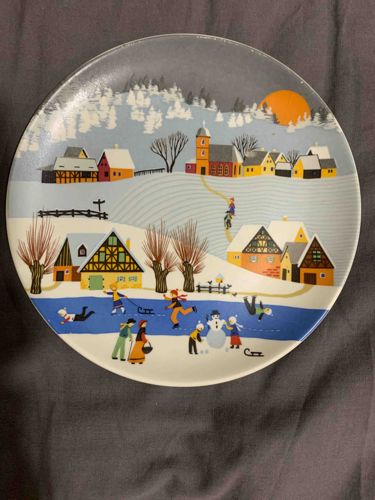
This is a circular decorative plate featuring a vibrant and whimsical winter village scene. The plate's design depicts a snow-covered landscape with various buildings, including houses, barns, and a church with a tall steeple, all rendered in a cheerful, somewhat folk-art style. The color palette primarily includes cool tones of blue and gray for the sky and snow, accented by warm yellows, reds, oranges, and browns for the structures and bare tree branches. A prominent feature is an orange sun low on the horizon, suggesting either sunrise or sunset. The foreground is dominated by a lively ice skating scene on a blue frozen body of water, where numerous figures are engaged in various winter activities. Some figures are skating, one appears to have fallen, others are building a snowman, and a few are walking. The figures are stylized, with simple yet expressive forms. Notable features include intricate details on some buildings, such as cross-timbering on one house and windows on others, as well as fences and a path leading up a snowy hill towards the church. The construction appears to be ceramic or porcelain, typical for decorative plates. No obvious chips, cracks, or significant wear are visible from the provided image, indicating good condition. The rim of the plate is subtly defined. The overall aesthetic suggests a mid-20th century, possibly Scandinavian or European, design influence, often associated with holiday decor or collectible art plates. Without a view of the back, specific maker's marks or an exact age cannot be determined, but the style points to a collectible market for seasonal or themed items.
AI Appraisal Report
Based on my visual examination of the Winter Village Ice Skating Decorative Plate, I find it to be in excellent condition. There are no visible chips, cracks, crazing, or significant wear on the surface or rim, suggesting it has been well-preserved, likely as a display piece. The colors remain vibrant. Authenticity-wise, without maker's marks or a physical inspection, specific attribution is impossible. However, the folk-art whimsical style is consistent with decorative plates produced from the mid-20th century onwards, often for seasonal or collector markets. Its design, with a winter village and ice skating scene, points to a 'holiday plate' category.
Market conditions for decorative plates like this are generally moderate. While charming, they are not typically rare, and the collectibility is often tied to specific brands (e.g., Royal Copenhagen, Bing & Grondahl Christmas plates) or artists, which cannot be confirmed here. Comparables include other general 'winter village' or 'ice skating' themed decorative plates, which usually retail between $20 and $80 depending on size, specific artistry, and brand. The lack of a known artist or prominent manufacturer limits its appeal to a broader collector base, placing it more in the general decorative item category. Demand exists primarily from individuals looking for festive home decor.
Factors impacting value include its appealing aesthetic, good condition, and potential for holiday display. The main limitation is the absence of provenance, maker's marks, and a physical inspection. For full authentication and to potentially identify a specific manufacturer or artist, an in-person examination of the reverse side for marks would be essential. This would also allow for tactile assessment of material quality and examination under magnification for any subtle imperfections not visible in the image.