AI Appraisal Estimate

AI-generated estimates · not official valuations

From the user

What was submitted

Photo and notes provided by the user — not generated by AI

Submitted item photo
Submitted photo · June 4, 2026

User's notes

No additional notes provided.

AI analysis below

AI appraisal

AI analysis & estimate

AI-Generated · Verify before acting

Everything below is generated by AI for informational purposes only. AI can make mistakes — the AI may misidentify items or misattribute them (artist, maker, brand, designer, origin, era). This is not an official valuation and should not be used for insurance, sale, tax, estate, legal, or lending purposes — or any decision requiring a certified appraisal. It is not an authoritative claim about any person, brand, or rights holder — do not share or rely on it as a factual statement about a third party. Always consult qualified professionals before making financial decisions.

Read the full disclaimer

AI Identification

·Not independently authenticated·Verify before acting

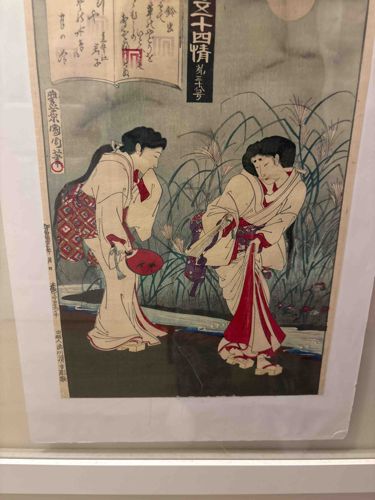
Tsukioka Yoshitoshi Ukiyo-e Woodblock Print from 'Twenty-Four Accomplishments in Imperial Japan'

Japanese Art & Antiques

AI Estimated Value

·Not an official valuation·Verify before acting

$450 - $700

As of June 4, 2026

AI Item Analysis

·AI can make mistakes·Verify before acting
This is an original Japanese ukiyo-e color woodblock print, likely part of the series 'Twenty-Four Accomplishments in Imperial Japan' (Koku-nijushi-ko) by the renowned Meiji-era artist Tsukioka Yoshitoshi. The print depicts two young women in traditional kimono and geta sandals standing amidst tall susuki (pampas) grass, one holding a red handheld fan. The composition is vertically oriented with a cartouche at the top containing an open book illustration and calligraphic text. The colors are characteristic of the Meiji period, featuring soft cream tones for the robes accented by vibrant reds and deep patterns in the obi. The background utilizes a subtle gradation of grey and green. Notable features include the detailed linework in the hair and clothing folds, as well as the artist's signature and publisher's seals along the left margin. The condition appears fair to good for its age; there is visible foxing (brown spotting) in the upper sky area and some light vertical creasing or staining, particularly along the right side. The paper shows age-related toning typical of late 19th-century washi paper. The craftsmanship is high, exhibiting precise registration of the woodblocks and careful color application consistent with the artistry of the Yoshitoshi studio during the 1880s to early 1890s.
AI Appraisal Report

·AI can make mistakes·Verify before acting
I have carefully examined the digital representations of this woodblock print from Tsukioka Yoshitoshi’s series 'Twenty-Four Accomplishments in Imperial Japan' (c. 1881-1893). The piece exhibits the hallmarks of an authentic Meiji-era production, including the mastery of linework—particularly the fine strands of hair—and the specific use of aniline dyes and mineral pigments typical of the 1880s. The artist’s seal and the publisher’s markings (Sasaki Toyokichi) are consistent with known original editions. Condition is a primary driver of value here. The visible foxing in the upper quadrant and the vertical center crease significantly impact the aesthetic and structural integrity, placing this in the 'fair to good' category. However, the vibrancy of the reds and the preservation of the delicate blind-printing (karazuri) or burnishing often found in this series bolster its appeal. Yoshitoshi remains the most collected Meiji artist; while his 'One Hundred Aspects of the Moon' commands higher premiums, the 'Twenty-Four Accomplishments' is highly sought after for its historical narratives and elegant female figures. While the visual indicators—paper texture, color bleed on the verso (implied), and registration—point toward authenticity, a definitive valuation requires in-person inspection. I cannot verify the presence of backing paper or thinning (mushi-kui) from images alone. A physical examination using raking light would confirm if the paper is genuine 19th-century 'washi' and ensure the print is not a high-quality mid-century offset lithograph or a modern digital reproduction. Comparison against known museum specimens regarding sheet size (oban) and margin notations would provide final confirmation of its state.

Get your items appraised

Instant estimates of your treasures with AI-powered appraisals

Browse More Appraisals