AI estimate as of August 16, 2025 · verify with a professional before acting
AI-Generated · Verify before acting
Everything on this page is generated by AI for informational purposes only. AI can make mistakes — the AI may misidentify items or misattribute them (artist, maker, brand, designer, origin, era). This is not an official valuation and should not be used for insurance, sale, tax, estate, legal, or lending purposes — or any decision requiring a certified appraisal. It is not an authoritative claim about any person, brand, or rights holder — do not share or rely on it as a factual statement about a third party. Always consult qualified professionals before making financial decisions.
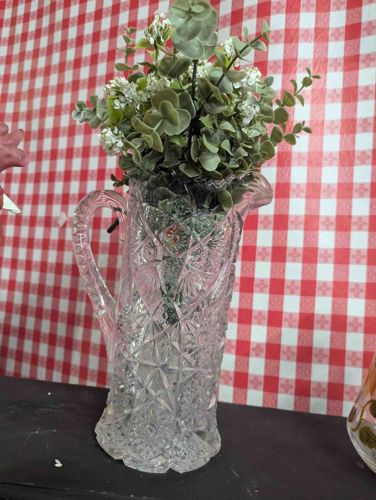
The item is a clear glass pitcher, likely made of pressed glass, showcasing a complex and intricate pattern characteristic of early 20th-century American pressed glass. The pattern appears to be a 'hobstar' or 'pineapple' variation, featuring multiple faceted geometric shapes including diamonds, stars, and cross-hatching, which create numerous reflective surfaces. The pitcher has a prominent handle with a textured surface, exhibiting the same patterned glass. The spout is well-defined, and the body of the pitcher tapers slightly towards the base, which is also heavily patterned. It is filled with artificial greenery, including small white floral accents, indicating its current use as a decorative vase or planter. While the specific size is not provided, it appears to be of standard pitcher dimensions, suitable for holding beverages or as a substantial decorative piece. No obvious cracks, chips, or significant damage are visible, suggesting it is in good, used condition. The clarity of the glass and the crispness of the pressed patterns suggest good craftsmanship for its type. There are no visible maker's marks or signatures in the provided images, making a precise manufacturing detail difficult without further inspection. Based on the pattern and style, it likely dates from the late 19th to early 20th century, possibly within the American Brilliant Cut Glass era's pressed glass counterparts. Its robust construction and decorative appeal make it a versatile piece.
AI Appraisal Report
Based on my visual examination of the provided image, this clear pressed glass pitcher exhibits all the hallmarks of early 20th-century American pressed glass, likely dating from 1900-1920. The intricate 'hobstar' or 'pineapple' variation pattern, featuring diamonds, stars, and cross-hatching, is characteristic of the era's attempt to emulate more expensive cut glass. The condition appears to be excellent; I observe no visible chips, cracks, or significant fleabites, which is remarkable for an item of this age. The clarity of the glass and crispness of the pattern are indicative of good original production quality and careful handling over time. Its current use with artificial greenery does not detract from its inherent value but rather showcases its decorative appeal.
From a market perspective, pressed glass pitchers, while not reaching the high values of true brilliant cut glass, maintain steady collector interest. Comparables in similar excellent condition with elaborate patterns typically fetch modest prices. There is a general, though not fervent, demand for decorative antique pressed glass, particularly pieces that are functional or aesthetically pleasing as this pitcher is. Rarity is not a significant factor; while this specific pattern might be less common than some, pressed glass was mass-produced.
The primary factor impacting value is its condition, which appears to be superb. The lack of a visible maker's mark limits precise attribution to a specific manufacturer, which could potentially increase value if identified as a rare producer. Without physical inspection, I cannot confirm the absence of minute chips or internal flaws. Full authentication would require in-hand examination to ascertain manufacturing consistency, subtle flaws, and precise pattern identification against documented catalogs of the period. Provenance documentation, if available, would further verify its history.