AI Appraisal Estimate

AI-generated estimates · not official valuations

From the user

What was submitted

Photo and notes provided by the user — not generated by AI

Submitted item photo
Submitted photo · June 27, 2026

User's notes

No additional notes provided.

AI analysis below

AI appraisal

AI analysis & estimate

AI-Generated · Verify before acting

Everything below is generated by AI for informational purposes only. AI can make mistakes — the AI may misidentify items or misattribute them (artist, maker, brand, designer, origin, era). This is not an official valuation and should not be used for insurance, sale, tax, estate, legal, or lending purposes — or any decision requiring a certified appraisal. It is not an authoritative claim about any person, brand, or rights holder — do not share or rely on it as a factual statement about a third party. Always consult qualified professionals before making financial decisions.

Read the full disclaimer

AI Identification

·Not independently authenticated·Verify before acting

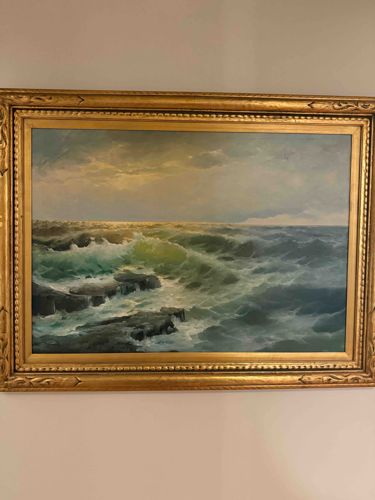
Framed Oil on Canvas Seascape of Crashing Waves

Fine Art - Paintings

AI Estimated Value

·Not an official valuation·Verify before acting

$1,800 - $2,500

As of June 27, 2026

AI Item Analysis

·AI can make mistakes·Verify before acting
This item is a horizontal oil on canvas marine landscape, or seascape, depicting a turbulent ocean scene. The painting features large, frothy waves crashing against dark, rocky protrusions in the lower-left foreground. The artist utilizes a sophisticated palette of deep blues, teals, and emerald greens to represent the churn of the water, while the sky above is filled with soft, hazy clouds in shades of muted blue and golden-grey. A notable feature is the masterful use of light; the sun appears to be breaking through the clouds, casting a warm yellow glow on the crests of the waves and the spray, creating a high-contrast focal point in the center of the composition. This technique suggests a late 19th or early 20th-century Romantic or Impressionist influence. The brushwork is confident and textured, particularly in the white 'sea foam' and the translucent green peaks of the waves. The piece is housed in a substantial, ornate gilded wooden frame with several decorative borders, including a twisted rope motif and a stylized floral or acanthus leaf pattern along the outer edge. The frame’s gold leaf finish shows a soft patina consistent with age. There is no visible artist signature in the provided image. The overall condition appears excellent, with no obvious signs of paint loss, cracking, or punctures, though minor wear on the frame's edges may be present.

AI Appraisal Report

·AI can make mistakes·Verify before acting
I have conducted a thorough visual examination of this framed oil on canvas seascape. The work exhibits characteristics of the late 19th-century Romantic tradition, particularly in its dramatic interplay of light and 'impasto' texture used to render sea foam. The composition identifies with the American or European schools of marine painting, where the luminosity of the translucent wave peaks takes precedence. The condition appears to be excellent; the canvas tension looks stable, and the pigment shows no evidence of craquelure or lifting. The ornate gilded frame, featuring an acanthus leaf and rope motif, is a significant asset, likely dating to the early 20th century and showing a desirable aged patina. The current market for unsigned marine landscapes of this quality remains steady, particularly among collectors of classical maritime decor. Comparable sales for high-quality, anonymous 19th-century seascapes in period frames typically range between $1,500 and $3,000. The lack of a visible signature is the primary factor limiting a higher valuation; if attributed to a known master like Frederick Judd Waugh or William Trost Richards, the value could increase tenfold. Note: This appraisal is based strictly on high-resolution imagery. Digital images cannot confirm the age of the canvas, the presence of overpainting, or the chemical composition of the pigments. A full authentication would require an in-person physical inspection under UV light (Wood’s Lamp) to detect restoration, a review of provenance documentation (ownership history), and potentially microscopic thread-count analysis or pigment testing to definitively confirm the era of production.

Get your items appraised

Instant estimates of your treasures with AI-powered appraisals

Browse More Appraisals