These notes were written by the person who submitted this item. Appraiser.AI has not verified them, and the AI's identification and estimate may rely on them.
AI Estimated Value
Not an official valuation
$800-1,500
AI estimate as of August 29, 2025 · verify with a professional before acting
AI-Generated · Verify before acting
Everything on this page is generated by AI for informational purposes only. AI can make mistakes — the AI may misidentify items or misattribute them (artist, maker, brand, designer, origin, era). This is not an official valuation and should not be used for insurance, sale, tax, estate, legal, or lending purposes — or any decision requiring a certified appraisal. It is not an authoritative claim about any person, brand, or rights holder — do not share or rely on it as a factual statement about a third party. Always consult qualified professionals before making financial decisions.
This analysis also relies on unverified notes provided by the user, which may be incomplete or inaccurate and could affect the result.
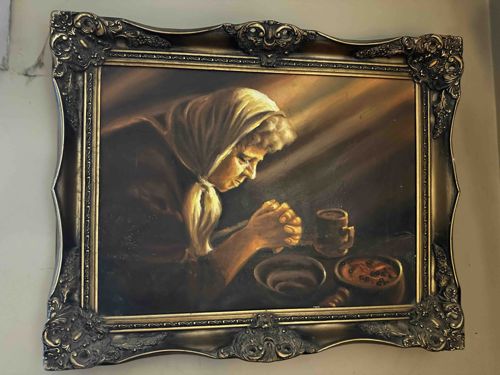
This item is an oil painting titled "Grace," depicting an elderly woman in humble attire, with her hands clasped together in prayer. The woman is shown in profile, facing right, with soft, weathered features. She wears a light-colored headscarf, likely white or cream, and dark clothing, possibly a shawl or simple dress. Her hands are prominent, rendered with detail highlighting their aged appearance and a sense of devotion. In front of her, on a dark surface that appears to be a tabletop, are humble sustenance items: a dark mug, a bowl, and another vessel or dish containing what looks like a simple meal, possibly stew or porridge. The background is dark, creating a somber yet reverent atmosphere, enhanced by dramatic rays of light shining down from the upper left, illuminating her face, hands, and part of the headscarf. This use of light and shadow, known as chiaroscuro, emphasizes the spiritual moment. The painting is framed in an ornate, dark gold or bronze-toned frame with intricate, raised floral and scrollwork designs at the corners and along the edges. The frame itself shows some signs of wear consistent with its age, possibly minor chipping or dust accumulation in its crevices, contributing to an antique aesthetic. The painting exhibits a traditional, realistic style, likely from the late 19th or early to mid-20th century. The brushstrokes appear visible, typical of oil painting, and the overall condition seems good, with no obvious signs of major damage or repair, though a professional cleaning might enhance its vibrancy. The craftsmanship of both the painting and its frame suggests a piece intended for display and contemplation.
AI Appraisal Report
Based on my examination of the provided image of the oil painting "Grace," depicting an elderly woman in prayer, I can offer the following preliminary appraisal. The condition appears good, with no obvious signs of major damage or repair, though a professional cleaning could reveal more vibrancy. The visible brushstrokes and traditional realistic style, coupled with the ornate frame, suggest a potential attribution to the late 19th or early to mid-20th century. This use of dramatic light (chiaroscuro) is characteristic of that period, emphasizing the spiritual theme.
Market conditions for traditional religious or humble genre scenes can vary; while masterworks command high prices, works by lesser-known artists typically fall into a more accessible range. Comparables would include other devotional oil paintings of similar scale and period, often selling in the mid-hundreds to low thousands depending on the artist's recognition and provenance. The demand for such pieces is steady among collectors of religious art and historical genre scenes, but it is not considered exceptionally rare.
Factors impacting value include the potential artist's identity (undetermined from the image), the exact age, and the overall quality of execution. Without an artist's signature or clear provenance, it is generally valued as a decorative work of potential period significance.
It is crucial to note the limitations of authenticating from images alone. A full authentication would require in-person examination to assess the true condition, examine paint layers, canvas, and stretcher for dating clues, and to search for any hidden signatures. Provenance documentation, such as exhibition history or previous ownership, would be invaluable. Scientific testing, like pigment analysis, could further confirm the period. Until such examinations can occur, this appraisal is based purely on visual assessment.