AI Appraisal Estimate

AI-generated estimates · not official valuations

From the user

What was submitted

Photo and notes provided by the user — not generated by AI

Submitted item photo
Submitted photo · May 26, 2026

User's notes

No additional notes provided.

AI analysis below

AI appraisal

AI analysis & estimate

AI-Generated · Verify before acting

Everything below is generated by AI for informational purposes only. AI can make mistakes — the AI may misidentify items or misattribute them (artist, maker, brand, designer, origin, era). This is not an official valuation and should not be used for insurance, sale, tax, estate, legal, or lending purposes — or any decision requiring a certified appraisal. It is not an authoritative claim about any person, brand, or rights holder — do not share or rely on it as a factual statement about a third party. Always consult qualified professionals before making financial decisions.

Read the full disclaimer

AI Identification

·Not independently authenticated·Verify before acting

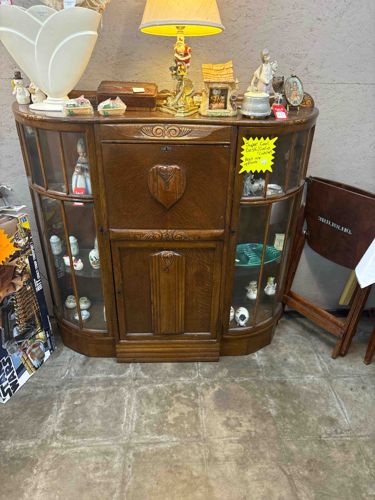
Early 20th Century Oak Side-by-Side Secretary Desk and Curio Cabinet

Antique Furniture

AI Estimated Value

·Not an official valuation·Verify before acting

$450 - $650

As of May 26, 2026

AI Item Analysis

·AI can make mistakes·Verify before acting
This is a multifaceted piece of furniture, commonly referred to as a 'side-by-side' secretary. It is constructed from solid oak and oak veneers, featuring a central drop-front desk compartment flanked by two curved-glass curio display cabinets. The central desk section is ornamented with a prominent carved wooden shield or heart-shaped applique on the drop-front and Art Nouveau-inspired foliate scrollwork along the top frieze. Below the desk is a solid wooden cabinet door with vertical fluting details. The side cabinets feature original bent/bowed glass panes held within wooden muntins, and they open to reveal interior glass shelving currently used to house various knick-knacks. The overall finish is a medium-to-dark honey oak stain. Condition-wise, the piece shows visible wear consistent with an age of roughly 100-120 years; there is noticeable scuffing and finish loss along the upper edges and base, particularly on the rounded molding and around the locksets. The drop-front shows a keyhole, though no key is visible. The piece stands on a recessed plinth base rather than traditional claw feet, suggesting a manufacturing date between 1900 and 1920. The craftsmanship reflects mass-produced quality from the American golden oak era, meant for the middle-class Victorian or Edwardian home.
AI Appraisal Report

·AI can make mistakes·Verify before acting
Based on my examination of the high-resolution images provided, I have assessed this side-by-side secretary desk and curio cabinet. The piece reflects the mass-production techniques of the American Golden Oak era, typically dating between 1900 and 1915. The use of bowed glass, golden oak veneers, and Art Nouveau-inspired foliate appliques indicates a piece intended for the burgeoning middle-class market of the early 20th century. The condition is fair to good for its age; while the structural integrity appears sound, there is significant finish loss and scuffing on the base and upper cornices that would require professional conservation to achieve top-market value. The market for large, specialized 'brown furniture' remains soft. Modern buyers often find these pieces difficult to integrate into contemporary decor, though the 'side-by-side' remains more desirable than standalone secretaries due to the display utility of the glass cabinets. Comparable sales in regional auctions and antique malls show similar models fetch between $400 and $700 depending on the condition of the glass and the presence of original keys. Several limitations exist with a digital-only assessment. I cannot verify the smoothness of the drawer glides, the stability of the drop-front hinges, or whether the glass is original 'wavy' period glass or later replacements. A physical inspection would be required to examine joinery techniques (such as dovetailing) and to check for manufacturer marks or labels often hidden on the back panel or underside. No scientific testing was performed; full authentication would require provenance documentation or a hands-on review to confirm the oak species and internal secondary woods.

Get your items appraised

Instant estimates of your treasures with AI-powered appraisals

Browse More Appraisals