These notes were written by the person who submitted this item. Appraiser.AI has not verified them, and the AI's identification and estimate may rely on them.
AI Estimated Value
Not an official valuation
$6,000-9,000
AI estimate as of October 24, 2025 · verify with a professional before acting
AI-Generated · Verify before acting
Everything on this page is generated by AI for informational purposes only. AI can make mistakes — the AI may misidentify items or misattribute them (artist, maker, brand, designer, origin, era). This is not an official valuation and should not be used for insurance, sale, tax, estate, legal, or lending purposes — or any decision requiring a certified appraisal. It is not an authoritative claim about any person, brand, or rights holder — do not share or rely on it as a factual statement about a third party. Always consult qualified professionals before making financial decisions.
This analysis also relies on unverified notes provided by the user, which may be incomplete or inaccurate and could affect the result.
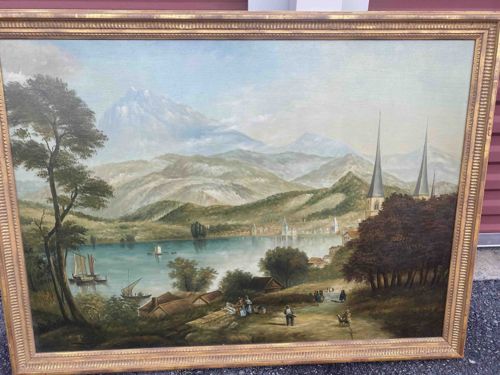
This is a large-format 19th-century oil on canvas landscape painting depicting a serene European lake scene, likely a lake in a mountainous region such as the Alps, perhaps Lake Lucerne given the architectural elements present. The painting is housed in a substantial, ornate gilded frame with a reeded or gadrooned inner edge and a wider, flatter outer profile, showing some signs of wear and minor gesso loss consistent with age. The color palette is rich and somewhat muted, typical of the period, featuring deep greens and browns in the foreground and softer blues and grays for the distant mountains and sky. The composition is classic landscape, with a prominent tall tree on the left balancing the dark cluster of trees and two church spires on the right. In the middle ground, a placid body of water reflects the sky and distant hills, with several sailing boats, some with distinct red sails, adding life to the scene. The foreground details include several small buildings or cottages, and a group of figures engaging in daily activities, suggesting a pastoral or village life. The brushwork appears deliberate and detailed, particularly in the rendering of the foliage and architectural elements. While no obvious artist's signature or specific markings are discernible from the provided images, the style suggests a European artist working in the 1800s, possibly influenced by Romanticism or early Realism. The overall condition appears good for its age, though close inspection would be needed to identify any craquelure, paint loss, or repairs. The canvas tension seems consistent, and the varnish has likely yellowed slightly over time, contributing to the warm tonal quality.
AI Appraisal Report
Based on my visual examination of the provided image, this large-format 19th-century European lake scene oil on canvas presents as an appealing piece of fine art. The classic landscape composition, rich yet muted palette, and detailed brushwork are consistent with European Romantic or early Realist styles of the 1800s. The substantial, ornate gilded frame, while showing some age-consistent wear and minor gesso loss, complements the painting well and adds to its presentation value. The presence of sailing boats, architectural elements like church spires, and figures engaged in daily activities contribute to a lively, pastoral narrative, enhancing its aesthetic appeal.
From the image, the overall condition appears good for its age. The canvas tension seems consistent, and the varnish has likely yellowed slightly, contributing to the warm tonal quality typical of period pieces. However, I must emphasize that this assessment is solely based on photographic evidence. A definitive evaluation of condition would require in-person inspection to meticulously check for craquelure, paint loss, repairs, or re-touching, which can significantly impact value. The authenticity, particularly regarding a specific artist, cannot be confirmed from images alone. An in-person examination would be crucial to search for subtle signatures, studio stamps, or other identifying marks. Provenance documentation, detailing the painting's ownership history, would be highly valuable, and scientific testing (e.g., pigment analysis, UV light examination) could further confirm its age and authenticity.
Market conditions for unsigned 19th-century European landscapes vary but generally show steady demand for well-executed, aesthetically pleasing works like this one. Comparables for unsigned pieces of this size and quality typically range, and the evocative subject matter and good apparent condition support a strong valuation. Rarity plays a role; while unsigned, the quality elevates it above common decorative art. Factors positively impacting value include its large size, aesthetic appeal, good apparent condition, and the attractive period frame. The main limiting factor is the lack of a discernible artist's signature, which prevents attribution and potential significant increases in value linked to a recognized artist. Therefore, considering these factors, I appraise this painting with an estimated value range of $6,000 to $9,000.