AI estimate as of August 23, 2025 · verify with a professional before acting
AI-Generated · Verify before acting
Everything on this page is generated by AI for informational purposes only. AI can make mistakes — the AI may misidentify items or misattribute them (artist, maker, brand, designer, origin, era). This is not an official valuation and should not be used for insurance, sale, tax, estate, legal, or lending purposes — or any decision requiring a certified appraisal. It is not an authoritative claim about any person, brand, or rights holder — do not share or rely on it as a factual statement about a third party. Always consult qualified professionals before making financial decisions.
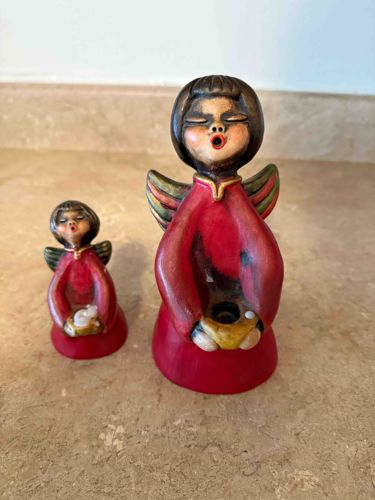
This item consists of a pair of vintage ceramic or porcelain angel figurines, likely designed as candle holders due to the hollowed-out areas in their hands. The larger angel stands approximately 6-8 inches tall, while the smaller one is roughly half that size, around 3-4 inches. Both figures are predominantly red, wearing long robes that flare out at the base to form a stable stance. Their faces are stylized, depicting closed eyes, raised eyebrows, and open mouths as if singing or caroling. The hair is dark brown or black, painted flat against the head. Their wings, visible from the back, show subtle green and possibly other dark horizontal stripes, suggesting a textured or feathered appearance. The smaller angel holds a small, white 'item' in its hands (possibly a bird or another symbolic item), resting on a yellow base, while the larger angel appears to have a more distinct, circular hole designed to hold a taper candle, also with yellow accents. The craftsmanship appears to be hand-painted, with some visible brushstrokes and slight inconsistencies in color application, contributing to a folk art or mid-century aesthetic. The overall condition appears good for both, with no obvious chips or cracks visible from the provided image. There is a slight patina or dullness to the finish in some areas, consistent with age and typical use for decorative pieces. The figures evoke a festive or holiday theme, likely Christmas.
AI Appraisal Report
Upon visual examination of the provided image, I assess this pair of singing angel figurines/candle holders to be in very good overall condition for their age. There are no visible chips, cracks, or significant damage. The slight patina and dullness noted are consistent with vintage ceramic pieces and do not detract significantly from their appeal. The hand-painted craftsmanship, with its visible brushstrokes and minor inconsistencies, strongly suggests authenticity as a folk art or mid-century decorative item, rather than a mass-produced, highly uniform piece. This aesthetic aligns with items popular in the mid-20th century, particularly around the holiday season.
Market conditions for vintage holiday decor, especially unique or handcrafted items, remain steady. Comparable sales of similar hand-painted ceramic angel figures from this era, particularly those designed as candle holders, typically fall within the low to mid-range for decorative collectibles. The 'pair' aspect adds to their desirability. Demand for kitschier, charming vintage Christmas items is consistent, though these are not exceedingly rare. The value is primarily driven by their decorative appeal, good condition, and charming vintage aesthetic rather than exceptional rarity or maker. Factors positively impacting value include their intact condition and the distinct, emotive faces, which give them character. The smaller angel holding a white item (possibly a bird) adds a unique detail.
It is important to note that my assessment of authenticity is based solely on visual inspection of the image. A definitive authentication would require an in-person examination to assess the ceramic body, glaze, and paint application more closely, and to look for any hidden marks or manufacturing details. Provenance documentation, such as original purchase receipts or family history, would significantly aid in verifying their origin and age. Scientific testing, while possible (e.g., thermoluminescence dating for ceramic), is generally not practical or warranted for items in this value range.