AI estimate as of October 31, 2025 · verify with a professional before acting
AI-Generated · Verify before acting
Everything on this page is generated by AI for informational purposes only. AI can make mistakes — the AI may misidentify items or misattribute them (artist, maker, brand, designer, origin, era). This is not an official valuation and should not be used for insurance, sale, tax, estate, legal, or lending purposes — or any decision requiring a certified appraisal. It is not an authoritative claim about any person, brand, or rights holder — do not share or rely on it as a factual statement about a third party. Always consult qualified professionals before making financial decisions.
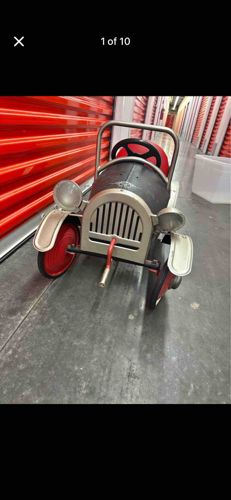
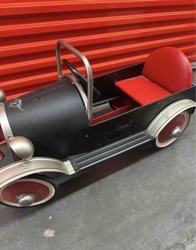
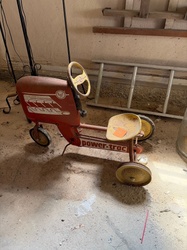
This is a vintage children's pedal car, designed to mimic the aesthetics of an early 20th-century automobile, likely from the 1920s or 1930s era given its styling. The main body of the car appears to be constructed from metal, possibly pressed steel, finished in a matte black or very dark gray paint, showing some wear and a slightly textured appearance. The prominent front grille is light-colored, possibly cream or light gray, with vertical slats, reminiscent of classic car grilles. Flanking the grille are two distinct headlights with clear lenses and chrome-like bezels, and below them are two small, light-colored fenders. The front wheels are solid red with red hubcaps, contrasting sharply with the dark body and light fenders. The rear wheels, though mostly obscured, also appear to be red. The car features a red seat and a black steering wheel, suggesting a classic color scheme. A steering column and possibly a pedal mechanism extends towards the front axle. Visible wear includes scuffs, paint loss, and minor surface imperfections consistent with age and use as a child's toy. The construction indicates a durable, utilitarian design typical of early pedal cars. There are no obvious maker's marks or signatures visible in the provided image. The overall condition suggests it is well-preserved for its age, though it exhibits the expected patina and signs of playful encounters.
AI Appraisal Report
Based on my examination of the provided image, this vintage children's pedal car, designed in the style of an early 20th-century automobile (likely 1920s-1930s), appears to be a well-preserved example. Its construction from metal, likely pressed steel, and its utilitarian design are consistent with authentic pedal cars from that era. The wear, scuffs, and paint loss are entirely commensurate with its age and intended use as a child's toy, contributing to its authentic patina rather than detracting significantly from its value. The prominent light-colored grille, chrome-like headlight bezels, and contrasting red wheels and seat suggest a desirable classic aesthetic.
Market conditions for vintage pedal cars, particularly those with a distinct classic car design, remain strong among collectors of automobilia, toys, and Americana. Comparable unrestored pedal cars from this period, especially those maintaining original components and paint finish (even if worn), typically fetch values in the mid-to-high hundreds, sometimes exceeding a thousand dollars for particularly rare or iconic models. The demand is steady, driven by nostalgia and an appreciation for historical toy craftsmanship. While not exceptionally rare, its good overall condition for its age makes it desirable.
Factors significantly impacting its value include its complete appearance, the visually appealing color scheme, and the apparent originality of its parts. The most significant limitation in this appraisal is the reliance solely on images. Without a physical inspection, I cannot verify the integrity of the internal mechanisms (pedals, steering linkage), confirm the absence of major structural repairs, or definitively identify the original manufacturing mark, which could either confirm a specific desirable maker or rule out a common one. Full authentication would require in-person examination to inspect material composition, functionality, and search for unseen maker's marks or restoration evidence, as well as checking any provenance documentation.