AI estimate as of September 7, 2025 · verify with a professional before acting
AI-Generated · Verify before acting
Everything on this page is generated by AI for informational purposes only. AI can make mistakes — the AI may misidentify items or misattribute them (artist, maker, brand, designer, origin, era). This is not an official valuation and should not be used for insurance, sale, tax, estate, legal, or lending purposes — or any decision requiring a certified appraisal. It is not an authoritative claim about any person, brand, or rights holder — do not share or rely on it as a factual statement about a third party. Always consult qualified professionals before making financial decisions.
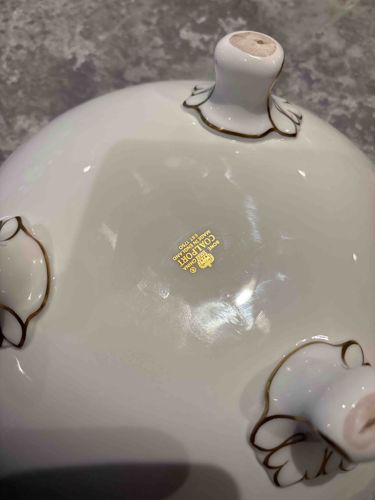
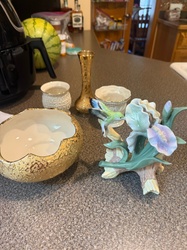
The item appears to be a portion of a white bone china compote or tazza, specifically the footed base. It features a glossy, pearlescent white glaze, suggesting high-quality porcelain. The construction reveals three prominent, decorative feet, each shaped with elegant curves and adorned with fine gold trim that outlines their form, particularly where they meet the main body of the dish. The gold trim shows excellent craftsmanship, applied consistently and with a delicate brushstroke. In the center of the visible surface, a gold foil sticker or decal is present, indicating the manufacturer. The text on the sticker clearly reads "BONE CHINA COALPORT MADE IN ENGLAND EST. 1750." This mark identifies the piece as being produced by Coalport, a renowned English porcelain manufacturer established in 1750, indicating its origin and likely a relatively modern production given the use of a foil sticker which is common for post-mid-20th century items. The top surface of one of the feet, which would typically be unglazed where it was fired, shows a slightly rougher, unglazed texture with some discoloration, likely from manufacturing or prior use. The overall condition appears to be very good with no visible chips, cracks, or significant wear to the glaze or gold trim, apart from the slight discoloration on the foot. The item exudes a sense of classic elegance and would have been used for serving fruits, candies, or other delicacies.
AI Appraisal Report
Based on my visual examination of the provided image, this Coalport Bone China Compote Dish or Tazza (Likely) appears to be in very good condition. The white bone china body presents with a high-quality, glossy, pearlescent glaze. The three decorative feet, adorned with finely applied gold trim, are intact, and the gold shows excellent retention, indicating minimal wear. The presence of the "BONE CHINA COALPORT MADE IN ENGLAND EST. 1750" gold foil sticker is a key authenticity indicator, typical of post-WWII Coalport production, likely mid to late 20th century. While the sticker confirms authenticity, it also suggests that this piece is not an antique from the earlier periods of Coalport, but rather a more modern collectible item. The slight discoloration on the top surface of one foot at the unglazed firing point is common and does not significantly detract from its value or condition.
In terms of market conditions, vintage bone china compotes or tazzas from renowned manufacturers like Coalport generally experience steady, albeit not exceptionally high, demand in the secondary market. Comparables for similar Coalport pieces of this age and style tend to range in the casual collector market. Rarity is not a significant factor here; while well-made, these types of decorative serving pieces were produced in reasonable quantities. The primary factors impacting value are the Coalport name, bone china quality, and its excellent preserved condition.
My assessment of authenticity is largely based on the visible mark. However, without physical inspection, I cannot account for hidden damage such as hairline cracks or repairs not visible in the image. Furthermore, without provenance documentation, the exact history of the piece remains unknown. Scientific testing, while not typically necessary for such items unless significant doubts arise, could confirm material composition. For full and definitive authentication, a hands-on examination would be crucial to assess the material 'feel,' weight, and to check for any invisible imperfections or restorations.