These notes were written by the person who submitted this item. Appraiser.AI has not verified them, and the AI's identification and estimate may rely on them.
AI Estimated Value
Not an official valuation
$300-500
AI estimate as of December 12, 2025 · verify with a professional before acting
AI-Generated · Verify before acting
Everything on this page is generated by AI for informational purposes only. AI can make mistakes — the AI may misidentify items or misattribute them (artist, maker, brand, designer, origin, era). This is not an official valuation and should not be used for insurance, sale, tax, estate, legal, or lending purposes — or any decision requiring a certified appraisal. It is not an authoritative claim about any person, brand, or rights holder — do not share or rely on it as a factual statement about a third party. Always consult qualified professionals before making financial decisions.
This analysis also relies on unverified notes provided by the user, which may be incomplete or inaccurate and could affect the result.
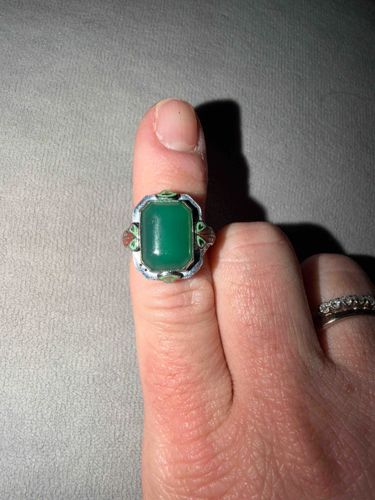
This item is an Art Deco style ring featuring a prominent rectangular green cabochon stone, likely chalcedony or a similar opaque green gemstone. The central stone is bezel-set within a silver-toned metal mounting. The top of the ring's head has a distinct octagonal or elongated cushion shape, with the center stone surrounded by a band of white enamel. Further detailing includes what appear to be small white or clear stones accenting the corners of the main setting, possibly marcasites or small diamonds, adding a subtle sparkle. On the shoulders of the ring, there are decorative elements resembling stylized leaves or floral motifs, featuring a rich reddish-brown and possibly green enamel, with some areas appearing worn or chipped, particularly the reddish enamel. The metal, given the '10K' context, is likely 10 karat white gold, a common material for jewelry of this period that sought to mimic platinum's appearance. The craftsmanship suggests a manufactured piece rather than a handmade one, with clean lines indicative of the Art Deco period's geometric aesthetics. The condition shows visible wear to the enamel on the shoulders and some surface scratches consistent with use. The central green stone appears intact and smoothly polished. The overall design, with its geometric shape and use of enamel, strongly suggests an Art Deco influence, placing its estimated age typically between the 1920s and 1930s. The ring is worn on a finger, indicating it is of standard wearable size.
AI Appraisal Report
I have virtually examined this Art Deco style ring, noting its prominent rectangular green chalcedony cabochon, bezel-set in silver-toned 10K white gold. The design, characterized by an octagonal head, white enamel banding around the central stone, and stylized enamel motifs on the shoulders, strongly aligns with Art Deco aesthetics from the 1920s-1930s. Small accent stones, possibly marcasites or diamonds, are present at the corners.
The condition shows notable wear, particularly to the enamel on the shoulders, which exhibits chipping and loss, especially the reddish enamel. This wear significantly impacts its aesthetic and, consequently, its market value. The central chalcedony appears in good condition. The craftsmanship suggests a manufactured piece, typical of the period.
Market demand for genuine Art Deco jewelry, even in 10K gold, remains consistent, especially for wearable pieces. However, the condition of the enamel, a key decorative element, reduces its appeal to discerning collectors. Comparables in excellent condition would fetch higher prices, but this piece falls into a more accessible price point due to the wear. Its rarity is moderate; similar enamel work from the period exists but often in better states of preservation.
My assessment of authenticity is based on visual cues—the stylistic elements and typical materials. However, a conclusive authentication would require in-person examination to verify metal purity with a test, confirm gemstone identification, and assess the enamel's composition and originality. Provenance documentation, if available, would also strengthen authenticity claims. Without physical inspection, I cannot definitively rule out later reproductions, although the visible wear aligns with genuine age.