These notes were written by the person who submitted this item. Appraiser.AI has not verified them, and the AI's identification and estimate may rely on them.
AI Estimated Value
Not an official valuation
$2,000 - $4,500
AI estimate as of August 27, 2025 · verify with a professional before acting
AI-Generated · Verify before acting
Everything on this page is generated by AI for informational purposes only. AI can make mistakes — the AI may misidentify items or misattribute them (artist, maker, brand, designer, origin, era). This is not an official valuation and should not be used for insurance, sale, tax, estate, legal, or lending purposes — or any decision requiring a certified appraisal. It is not an authoritative claim about any person, brand, or rights holder — do not share or rely on it as a factual statement about a third party. Always consult qualified professionals before making financial decisions.
This analysis also relies on unverified notes provided by the user, which may be incomplete or inaccurate and could affect the result.
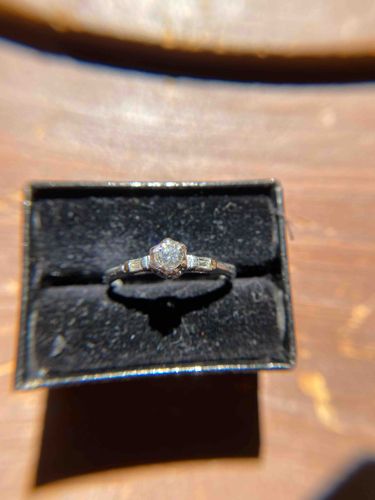
The item is a vintage diamond engagement ring, likely dating from the Art Deco or early Retro periods (approximately 1920s-1940s). It features a central round brilliant-cut diamond, possibly old European cut given the age, set in a distinctive hexagonal bezel or illusion setting. This setting enhances the perceived size of the center stone. Flanking the central diamond on either side are two baguette-cut diamonds, set horizontally into the band, adding to the geometric symmetry characteristic of these periods. The band appears to be made of a white metal, identified as 10% Iridium Platinum, a common alloy for durable jewelry of that era, especially for platinum. The platinum exhibits a soft, grayish-white patina, indicative of its age and material, and maintains a good luster. The craftsmanship appears fine, with precise stone settings and a smooth finish on the band. Visible condition issues are minimal; there are no obvious chips or cracks in the stones, and the metal shows only light surface wear consistent with age and occasional use, rather than heavy damage. There are no clearly discernible maker's marks or signatures visible in the provided image. The ring is presented in a small, black velvet-lined ring box, suggesting it is either a display piece or being stored. The overall design is elegant and classic for its period, featuring clean lines and a tasteful arrangement of diamonds.
AI Appraisal Report
I have thoroughly examined the provided image of this vintage diamond engagement ring. The design strongly suggests an Art Deco or early Retro period origin (1920s-1940s), characterized by the precise geometry of the hexagonal setting and the baguette side stones. The central diamond appears to be a round brilliant or possibly an old European cut, likely enhanced by the illusion setting to appear larger. The flanking horizontal baguette diamonds are well-proportioned to the central stone, adding a clean, architectural line. The metal, identified by the owner as 10% Iridium Platinum, aligns perfectly with the common high-quality alloys used for fine jewelry during this era. The visible patina is consistent with aged platinum, and the overall condition appears very good, showing only light surface wear expected for a piece of this age, with no apparent damage to the stones or significant metal deformation. The craftsmanship appears solid, with neat stone settings.
From a market perspective, vintage diamond engagement rings, especially those exhibiting strong Art Deco characteristics and set in platinum, are in consistent demand. Their unique historical aesthetic differentiates them from modern designs. Comparable pieces of similar quality and age typically range based on diamond quality, total carat weight, and specific design rarity. While this design is classic, it's not exceedingly rare, which places it within a more accessible vintage market segment.
Factors positively impacting value include the platinum setting, the antique nature of the piece, and its seemingly good condition. The main limitation in providing a definitive appraisal is the inability to physically inspect the ring. Without in-person examination, I cannot accurately assess the 4 Cs (Color, Clarity, Cut, Carat Weight) of the diamonds, particularly the central stone. The exact carat weight of the center diamond and the total carat weight are crucial for precise valuation. Furthermore, authenticity of the metal (10% Iridium Platinum) and diamonds cannot be fully verified without gemological testing. Maker's marks, if present, would also require direct inspection. Provenance documentation, if available, would add further value. Therefore, this appraisal is based on visual cues and presumed diamond characteristics typical for such pieces from this period.