AI estimate as of July 28, 2025 · verify with a professional before acting
AI-Generated · Verify before acting
Everything on this page is generated by AI for informational purposes only. AI can make mistakes — the AI may misidentify items or misattribute them (artist, maker, brand, designer, origin, era). This is not an official valuation and should not be used for insurance, sale, tax, estate, legal, or lending purposes — or any decision requiring a certified appraisal. It is not an authoritative claim about any person, brand, or rights holder — do not share or rely on it as a factual statement about a third party. Always consult qualified professionals before making financial decisions.
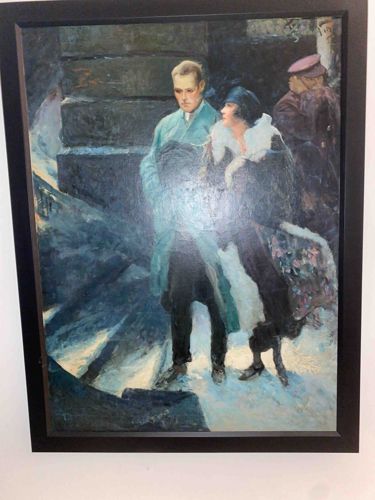
This is an oil painting on canvas, likely dating from the early to mid-20th century, possibly the 1920s or 1930s, given the fashion of the female figure. The overall color palette is dominated by cool tones, particularly blues, greens, and grays, with some hints of warmer tones in the skin and the floral arrangement. The painting depicts three figures in what appears to be an outdoor, possibly wintry or evening, setting with steps in the background. The central figures are a man and a woman. The man, on the left, is fair-skinned with light hair, wearing a high-collared shirt and a teal or light blue overcoat that covers most of his body. He has a somber or pensive expression. The woman, to his right, wears a dark, possibly fur-trimmed coat or shawl with a prominent white fur collar. She has dark hair styled in a bobbed haircut, typical of the flapper era, and appears to be looking towards the man. Her bare arms or gloves are visible. There's a floral arrangement in her left arm, possibly a bouquet, featuring various colors like pink, purple, and white. A third, less defined figure, partially obscured and possibly wearing a uniform or dark coat with a purple hat, stands in the upper right background. The foreground suggests a snowy or icy ground, with light reflections hinting at a cold atmosphere. The brushstrokes appear gestural and somewhat impasto in areas, particularly in the foreground and the woman's garments, suggesting a realist or impressionistic style. The painting is housed in a simple, flat-profile black frame, which appears to be a modern addition or a minimalistic choice. There are no obvious signs of significant damage such as tears or major paint loss, but there is some glare in the image, making it difficult to assess the exact condition and surface texture. The quality of craftsmanship appears high, with attention to character expression and drapery.
AI Appraisal Report
This oil painting, likely from the early to mid-20th century, depicts a compelling figurative scene. From my visual examination, the condition appears good; there are no obvious tears or significant paint loss, though glare in the image prevents a definitive assessment within areas like surface texture or subtle craquelure. The brushwork suggests a skilled hand, indicative of a realist or impressionistic style, with good attention to character expression and drapery.
Market demand for early to mid-20th century figurative works varies significantly by artist, provenance, and subject appeal. While the general style is appealing, lacking artist attribution or detailed provenance limits its market reach to collectors of unsigned, period pieces. Comparables for unsigned works of this quality and period typically fall within lower to mid-range values unless a strong artist can be confirmed. Factors impacting its value negatively are the lack of signature/provenance and the potential for it to be a decorative piece rather than by a recognized artist. Positively, the emotional depth and narrative suggested by the figures, particularly the woman's flapper-era styling, add visual interest and historical context.
Limitations in authenticity verification from images alone are substantial. I cannot definitively confirm who the artist is. A physical examination would be crucial to inspect for a signature, examine brushwork authenticity, and assess actual paint condition and canvas integrity. Provenance documentation, such as exhibition history or previous ownership, would be vital for full authentication and significantly impact value. Scientific testing, like pigment analysis, could help confirm the period.