AI Appraisal Estimate

AI-generated estimates · not official valuations

From the user

What was submitted

Photo and notes provided by the user — not generated by AI

Submitted item photo
Submitted photo · July 3, 2026

User's notes

No additional notes provided.

AI analysis below

AI appraisal

AI analysis & estimate

AI-Generated · Verify before acting

Everything below is generated by AI for informational purposes only. AI can make mistakes — the AI may misidentify items or misattribute them (artist, maker, brand, designer, origin, era). This is not an official valuation and should not be used for insurance, sale, tax, estate, legal, or lending purposes — or any decision requiring a certified appraisal. It is not an authoritative claim about any person, brand, or rights holder — do not share or rely on it as a factual statement about a third party. Always consult qualified professionals before making financial decisions.

Read the full disclaimer

AI Identification

·Not independently authenticated·Verify before acting

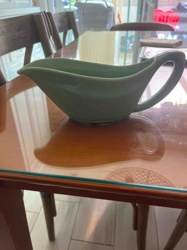
Mid-Century Modern 'Stardust' or 'Geometric' Pattern Ceramic Pitcher

Vintage Tableware / Mid-Century Modern Ceramics

AI Estimated Value

·Not an official valuation·Verify before acting

$35.00 - $60.00

As of July 3, 2026

AI Item Analysis

·AI can make mistakes·Verify before acting
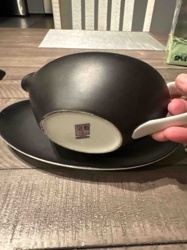
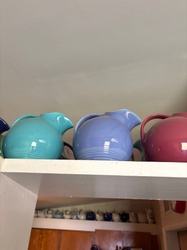
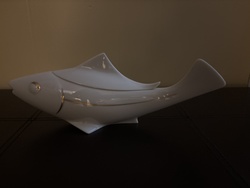
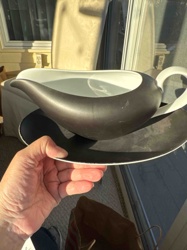
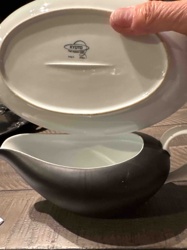
This item is a vintage ceramic cream or milk pitcher, prominently featuring a Mid-Century Modern aesthetic typical of the 1950s or 1960s. The vessel is constructed from a speckle-glazed stoneware or semi-vitreous earthenware, characterized by a light cream or off-white base color with fine, dark 'pepper' speckling integrated into the glaze. Its form is organic and teardrop-shaped with a slender, integrated pouring spout and a simple C-curved handle. The primary decorative element consists of an abstract geometric pattern appearing on the side, showcasing pink rectangular blocks overlaid with black linear crosses and small dots. This 'Atomic' or 'Stardust' style design is reminiscent of patterns popularized by manufacturers such as Franciscan (though often associated with Starglow or similar patterns) or various German/Japanese exporters of the era. The construction quality appears consistent with mass-produced tableware of the mid-20th century, utilizing molded casting techniques. There are no maker's marks visible on the exterior; any identifying stamps would likely be found on the unglazed foot ring. The condition appears fair to good, with no visible large cracks or major chips, although there is a slight yellowish staining or patina near the base likely from age or exposure to moisture. The glaze retains its original satin-to-gloss finish, and the transfer-ware graphics remain relatively crisp with minimal fading.
AI Appraisal Report

·AI can make mistakes·Verify before acting
Based on my visual examination of this mid-20th-century ceramic pitcher, I have identified it as a classic example of Atomic-era 'earthenware' likely produced by a high-volume manufacturer in Japan or the United States (such as Hall or various California potteries) during the late 1950s. The 'Stardust' pattern, featuring pink geometric blocks and black cross-hatched accents against a speckled cream glaze, is quintessential Mid-Century Modern (MCM) design. The condition appears structurally sound, though there is evident yellowish discoloration near the foot, suggesting moisture infiltration or 'crazing' under the glaze surface, which slightly depreciates the value. The market for MCM tableware remains steady, but value is highly dependent on the brand. Without a visible maker's mark (e.g., Franciscan or Red Wing), the piece is categorized as 'unattributed decorative art.' Market comparables for unmarked atomic-pattern pitchers of this size typically fluctuate between $30 and $55 at auction. High-demand patterns like Franciscan 'Star Burst' would command significantly more, but the lack of a mark limits this item's ceiling to the entry-level collector market. Limitations: My assessment is based solely on digital imagery. For a full authentication, I would need a physical inspection to verify the tactile quality of the glaze, check the foot ring for recessed stamps, and perform a 'ring test' to check for internal hairline fractures not visible to the eye. Scientific testing for lead content or provenance documentation from the original owner would be required to verify its production lineage definitively. The value provided assumes no major chips are hidden on the handle's underside or interior rim.

Get your items appraised

Instant estimates of your treasures with AI-powered appraisals

Browse More Appraisals