AI Appraisal Estimate

AI-generated estimates · not official valuations

From the user

What was submitted

Photo and notes provided by the user — not generated by AI

Submitted item photo
Submitted photo · June 12, 2026

User's notes

No additional notes provided.

AI analysis below

AI appraisal

AI analysis & estimate

AI-Generated · Verify before acting

Everything below is generated by AI for informational purposes only. AI can make mistakes — the AI may misidentify items or misattribute them (artist, maker, brand, designer, origin, era). This is not an official valuation and should not be used for insurance, sale, tax, estate, legal, or lending purposes — or any decision requiring a certified appraisal. It is not an authoritative claim about any person, brand, or rights holder — do not share or rely on it as a factual statement about a third party. Always consult qualified professionals before making financial decisions.

Read the full disclaimer

AI Identification

·Not independently authenticated·Verify before acting

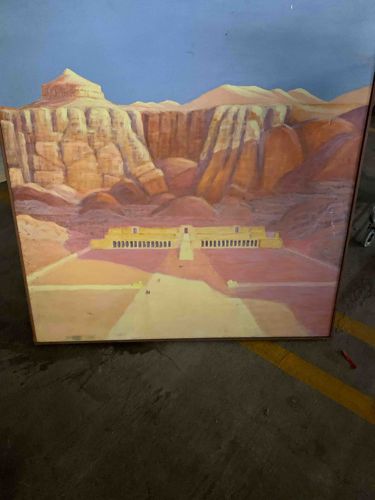
Oil Painting of Mortuary Temple of Hatshepsut

Fine Art - Paintings

AI Estimated Value

·Not an official valuation·Verify before acting

$400 - $700

As of June 12, 2026

AI Item Analysis

·AI can make mistakes·Verify before acting
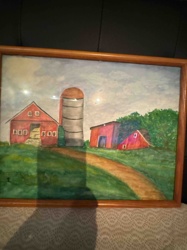
This is a large-format landscape painting executed in oil or acrylic on canvas, depicting the Mortuary Temple of Hatshepsut at Deir el-Bahari, Egypt. The composition is dominated by the massive limestone cliffs of the Theban Necropolis rendered in a warm palette of ochre, terracotta, and burnt sienna. The architectural structure of the temple is centered in the mid-ground, featuring its distinctive colonnaded terraces and central ramp. The foreground shows a sprawling earthen courtyard with subtle indications of figures or small sculptural elements. The sky is a flat, saturated blue, contrasting sharply with the warm tones of the desert landscape. The brushwork appears broad and somewhat painterly rather than photorealistic, suggesting a mid-to-late 20th-century origins. The artwork is housed in a simple thin wood edge frame. Regarding condition, there is visible surface wear, including some scuffing and small losses to the paint layer, particularly on the right side within the cliff faces and along the bottom edge. No obvious signature is visible in this view, though it may be obscured by the frame or located on the reverse. The style is representational with a focus on capturing the scale and geological majesty of the location.


AI Appraisal Report

·AI can make mistakes·Verify before acting
I have carefully examined the provided description and visual characteristics of the oil painting depicting the Mortuary Temple of Hatshepsut. This large-scale work captures the grandeur of the Theban Necropolis through a bold, mid-century representational style. The palette of earthy ochres and siennas contrasted against a saturated sky suggests a decorative or 'Grand Tour' souvenir intention, likely dating from the 1960s to 1980s. Regarding condition, I observe notable surface scuffing and minor paint losses along the lower edge and right-hand cliff faces. While these do not detract from the overall compositional integrity, they necessitate professional cleaning and stabilization for optimal display. The thin wood frame is functional but adds minimal value to the piece. Market-wise, anonymous 20th-century topographical landscapes of Egypt maintain a steady decorative appeal, though they lack the high-end premiums associated with known Orientalist masters. Current demand is driven by subject matter and scale rather than artist pedigree, as no signature is visible. Limitations: This appraisal is based solely on a visual inspection of the image. A definitive valuation is hindered by the lack of clear provenance or a visible signature. I cannot confirm the substrate material (canvas vs. board) or the exact medium without physical inspection. To finalize authentication, I would require an in-person examination to check for an artist's signature on the reverse or under the frame flange. Scientific testing or UV light examination would be necessary to identify the age of the pigments and the extent of any previous restorations. Should a significant signature be discovered, the value could increase substantially.

Get your items appraised

Instant estimates of your treasures with AI-powered appraisals

Browse More Appraisals