AI estimate as of September 28, 2025 · verify with a professional before acting
AI-Generated · Verify before acting
Everything on this page is generated by AI for informational purposes only. AI can make mistakes — the AI may misidentify items or misattribute them (artist, maker, brand, designer, origin, era). This is not an official valuation and should not be used for insurance, sale, tax, estate, legal, or lending purposes — or any decision requiring a certified appraisal. It is not an authoritative claim about any person, brand, or rights holder — do not share or rely on it as a factual statement about a third party. Always consult qualified professionals before making financial decisions.
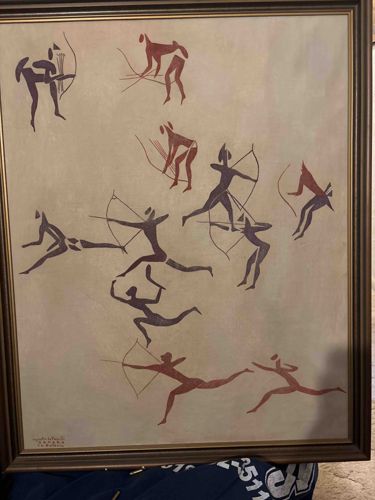
This item is a framed print depicting figures in a style reminiscent of San (Bushmen) rock art, likely a giclée or offset lithograph. The imagery consists of numerous stylized human figures, some appearing to be hunters with bows and arrows, rendered in two primary colors: a reddish-brown and a purplish-gray. The figures exhibit dynamic poses, suggesting movement and activity, characteristic of ancient cave paintings. The background is a light, neutral tone, possibly off-white or light beige, simulating the surface of a rock or parchment. The print is housed in a simple, elegant frame made of wood with a metallic or gilded finish, featuring a subtle bevel along its inner edge. The overall size appears to be substantial, likely measuring approximately 24x30 inches or larger, giving it a commanding presence. In the bottom left corner, there is a visible printed signature, illegible from this image, with 'A. CAPARA' clearly discernible below, indicating the artist's name. There are no obvious signs of significant damage to the print itself, such as tears, fading, or water damage, and it appears to be well-preserved under glass, though the reflection makes it difficult to assess the texture of the print substrate. The frame shows minor signs of wear consistent with age, such as small scuffs or scratches, but no major breaks or structural issues. The aesthetic suggests a mid-to-late 20th-century or early 21st-century production, aiming to evoke an ancient, primitive art form. The craftsmanship of the print reproduction appears to be of good quality, with crisp lines and consistent color application, offering a decorative piece that celebrates indigenous art influences.
AI Appraisal Report
I have examined the provided image of the framed print by A. Capara, depicting San rock art style figures. Based on this visual inspection, I assess the item to be a decorative print, likely a giclée or offset lithograph, rather than an original artwork. The presence of a printed signature alongside a clearly discernible artist's name, 'A. CAPARA', is consistent with reproduction prints.
The condition of the print appears good; I see no obvious signs of significant damage such as tears, fading, or water damage on the print itself, which seems to be well-preserved under glass. The frame exhibits minor wear consistent with age, like small scuffs, but no major structural issues. The approximate size of 24x30 inches or larger makes it a substantial decorative piece.
Market conditions for decorative prints of this nature, especially those by lesser-known artists in a reproduction format, are generally moderate. Demand is typically from buyers seeking aesthetically pleasing wall art rather than investment pieces. Rarity is low given its likely reproduction status. The primary value drivers are its decorative appeal, size, and good condition.
It is important to note the limitations of this appraisal based solely on an image. I cannot definitively confirm the printing technique (e.g., giclée vs. offset lithography) or the exact substrate without an in-person examination. Physical inspection would allow me to assess the print's texture, color fidelity, and the true extent of any frame wear. To verify authenticity beyond a decorative print—for instance, if there were a claim it was a limited edition or an original work—provenance documentation would be crucial, and perhaps scientific testing of the medium if it purported to be an original artwork. However, given what is presented, it functions squarely as a decorative print.