AI estimate as of October 6, 2025 · verify with a professional before acting
AI-Generated · Verify before acting
Everything on this page is generated by AI for informational purposes only. AI can make mistakes — the AI may misidentify items or misattribute them (artist, maker, brand, designer, origin, era). This is not an official valuation and should not be used for insurance, sale, tax, estate, legal, or lending purposes — or any decision requiring a certified appraisal. It is not an authoritative claim about any person, brand, or rights holder — do not share or rely on it as a factual statement about a third party. Always consult qualified professionals before making financial decisions.
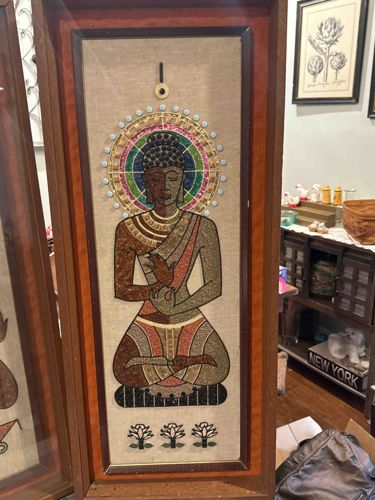
This item is a framed mixed-media artwork, featuring a seated Buddha figure created through an intricate inlay technique, most likely using various colors of seeds, grains, or possibly fine sand. The artwork is presented in a vertical, rectangular dark wood frame with a slight reddish-brown hue and a simple profile. The Buddha figure is depicted in a meditative 'lotus' position, with hands resting in front of the body. The body of the Buddha is rendered with different tones of brown and tan, suggesting a mosaic-like assembly of natural materials. The head features tightly curled 'hair' in a dark, possibly black, material. A halo or aureole encircles the Buddha's head, composed of concentric rings in vibrant colors like gold, green, pink, and blue, also created from the same granular medium. This halo is further accentuated by a series of small, light-colored circular elements, possibly beads or similar inlaid pieces, arranged around its perimeter. Above the Buddha's head, a single small circular element with a vertical line extending upwards acts as a symbolic urna or third eye. Below the seated figure, three stylized lotus flowers are depicted. The background of the artwork is a light, natural-colored fabric or paper, possibly linen or burlap, providing a rustic texture. The overall condition appears good, with no obvious signs of significant damage, though some minor dust or age-related patina on the frame is possible. The craftsmanship appears detailed and precise, indicating a careful assembly of the small constituent materials. This piece likely dates from the late 20th century to early 21st century, embodying a contemporary folk art or spiritual art style.
AI Appraisal Report
Having visually examined the Framed Mixed Media Buddha Artwork with Seed/Grain Inlay, I find it to be in good overall condition. The intricate inlay work, likely using seeds, grains, or fine sand, appears intact with no obvious losses or significant damage. The colors in the halo are vibrant, and the overall composition is well-executed, indicative of careful craftsmanship. The dark wood frame also seems to be in good shape, with possible minor age-related patina, which is common for artworks of this type. This piece falls into the category of contemporary folk art or spiritual art, likely produced from the late 20th to early 21st century.
Market conditions for such mixed-media, spiritual-themed artworks, particularly those utilizing natural materials, are generally stable, driven by aesthetic appeal and decorative value rather than historical significance or artist provenance. Comparable pieces, often found in artisan markets, specialty décor stores, or online craft platforms, typically range in price based on size, complexity, and material quality. While the demand for Buddha imagery is consistent, this particular style is not rare, contributing to a moderate market value.
Factors impacting value include the detailed craftsmanship and the good visual condition. The use of natural materials offers a unique tactile and visual appeal. However, the lack of artist signature, specific provenance, or established artistic reputation limits its top-tier market potential. Without in-person examination, a definitive authenticity verification of the materials or the age is not possible. A physical inspection would allow for closer examination of the inlay's adhesion, specific material identification (e.g., types of seeds/grains), and a more precise assessment of the frame's condition. Provenance documentation would be crucial to attribute it to a specific artist or workshop, significantly impacting its value beyond its decorative merit.