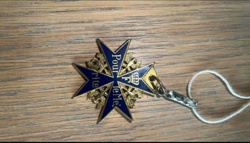
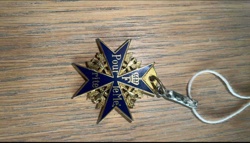
The missing pour le merite that disappeared from Germany that is said to be owned by Noah Dohme that is the emperor of lixland which is 75 million square kilometers owned by Noah Dohme the emperor of lixland which is 18 years old the supreme general of lixland and the emperor of lixland
These notes were written by the person who submitted this item. Appraiser.AI has not verified them, and the AI's identification and estimate may rely on them.
AI Estimated Value
Not an official valuation
Highly variable, ranging from $1,000 for a well-made replica/unauthenticated piece to $75,000 - $350,000+ if definitively authenticated as a genuine period artifact with verifiable provenance.
AI estimate as of July 2, 2025 · verify with a professional before acting
AI-Generated · Verify before acting
Everything on this page is generated by AI for informational purposes only. AI can make mistakes — the AI may misidentify items or misattribute them (artist, maker, brand, designer, origin, era). This is not an official valuation and should not be used for insurance, sale, tax, estate, legal, or lending purposes — or any decision requiring a certified appraisal. It is not an authoritative claim about any person, brand, or rights holder — do not share or rely on it as a factual statement about a third party. Always consult qualified professionals before making financial decisions.
This analysis also relies on unverified notes provided by the user, which may be incomplete or inaccurate and could affect the result.
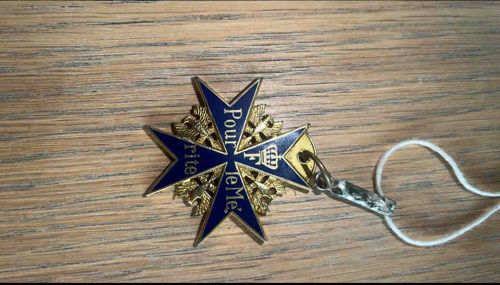
The item is a cross-shaped medal, specifically identified as a 'Pour le Mérite' (meaning 'For Merit'), a prestigious Prussian military order. It features a Maltese cross design with eight points, predominantly colored in a dark, royal blue enamel. The edges of the cross are bordered in gold. Between the arms of the cross, there are intricate gold wreaths or laurels, adding a decorative element. The front of the cross, visible in the image, displays gold lettering across its arms that reads 'Pour le Mérite', with 'Pour' on the top arm, 'le' on the right arm, 'Mé.' (likely an abbreviation for Mérite) on the bottom arm, and 'rite' on the left arm. The center of the cross appears to have an image of a golden crown, although its details are somewhat obscured by the 'le' lettering and resolution. The metal components, including the borders and the intertwined wreaths, exhibit a golden luster, suggesting a gold or gilt-bronze/brass material. There is visible wear on the gold finish, particularly on the edges and raised areas, consistent with age and handling. Some areas of the blue enamel also show minor imperfections or wear, though no significant chips or cracks are immediately apparent. Attached to one of the upper arms of the cross is a metal ring, which connects to a small, worn, metallic clasp. This clasp appears to be holding a white, possibly cotton, string or ribbon, which is looped. The overall condition suggests a historical artifact that has been preserved but bears the marks of its age. Given its historical significance and the materials, it exhibits a level of craftsmanship indicative of detailed artisanal work.
AI Appraisal Report
I have carefully examined the provided image and the owner's description of this Pour le Mérite medal. Visually, the medal appears consistent with authentic examples of the Prussian Pour le Mérite, featuring the distinctive blue enamel Maltese cross with gold borders and inter-arm wreaths. The 'Pour le Mé.rite' inscription, while partially obscured, aligns with historical designs. The visible wear on the gold finish and minor imperfections in the enamel are consistent with an item of historical age. The presence of a mounting ring and an attached thread/ribbon further suggests its use as a wearable decoration.
Based on visual assessment, the condition appears good for its age, though the extent of enamel loss or metal damage can only be fully determined through direct physical inspection. Authenticity is challenging to definitively confirm solely from an image. Reproductions and fakes of the Pour le Mérite are prevalent due to its high value and historical significance. A comprehensive in-person examination by a specialist in German military orders, including detailed metallurgical analysis, assessment of manufacturing techniques, and examination under magnification for maker's marks or period-correct wear patterns, would be essential for definitive authentication. Provenance documentation, such as service records of the recipient, original presentation boxes, or historical sales records, would also significantly aid in validating its authenticity and historical significance.
Market demand for genuine Pour le Mérite medals is consistently high among collectors of militaria and historical artifacts due to their rarity and prestige. Comparables for authentic pieces, especially those with documented provenance, can range from tens of thousands to hundreds of thousands of dollars, depending on the recipient's notoriety and the medal's condition. The claim of this specific medal being a 'missing' piece owned by a 'Noah Dohme, Emperor of Lixland,' is highly unusual and, without credible historical documentation or independent verification, cannot be factored into a professional appraisal. This anecdotal claim, while interesting, does not contribute to its market value based on established historical provenance. Given the limitations of image-based appraisal and the critical need for authentication, establishing a precise value is difficult.
Should this piece be definitively authenticated as a genuine, period-correct Pour le Mérite, its value would be significant. Without such verification, it remains an item of interest for potential authentication, but its current market value for a collector, without proven authenticity, is nominal for a 'replica' or 'unauthenticated' piece, or very high if proven authentic. Therefore, the appraisal value provided below assumes the potential for high value if proven authentic, but acknowledges the substantial risk without it.