AI estimate as of October 11, 2025 · verify with a professional before acting
AI-Generated · Verify before acting
Everything on this page is generated by AI for informational purposes only. AI can make mistakes — the AI may misidentify items or misattribute them (artist, maker, brand, designer, origin, era). This is not an official valuation and should not be used for insurance, sale, tax, estate, legal, or lending purposes — or any decision requiring a certified appraisal. It is not an authoritative claim about any person, brand, or rights holder — do not share or rely on it as a factual statement about a third party. Always consult qualified professionals before making financial decisions.
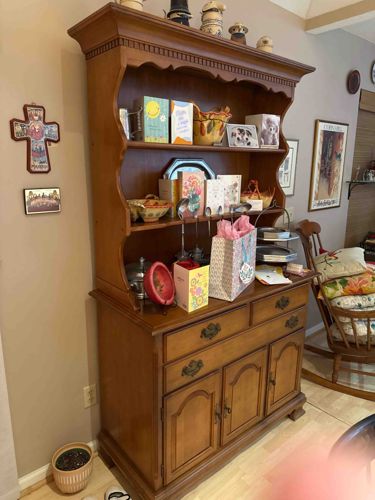
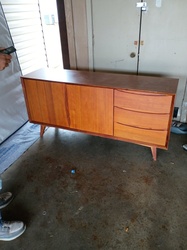
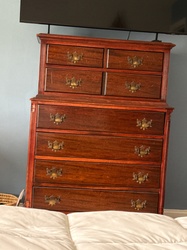
This is a traditional wooden china hutch, likely constructed from a solid hardwood such as oak, maple, or possibly cherry, or a veneer over a composite core. The hutch exhibits a warm, medium-brown finish with a satin sheen, showcasing visible wood grain. It is a two-piece unit consisting of an upper display cabinet and a lower buffet/sideboard.
The upper section features an arched, open display area with two fixed shelves, providing several compartments for decorative items. The back of the upper section appears to be solid wood. The top is crowned with decorative molding, and below this, there's a frieze with carved or routed detailing, possibly a dentil or egg-and-dart pattern, adding to its classic aesthetic. The sides of the display area are gently curved, contributing to a softer silhouette.
The lower section, which serves as a buffet, includes three drawers across the top, each fitted with ornate brass-toned bail pull handles and possibly a decorative backplate. Below the drawers are three cabinet doors that appear to open independently. These doors feature raised panel designs, providing depth and traditional appeal. The base of the hutch is supported by short, possibly turned or bracket style feet, elevating the piece slightly off the floor.
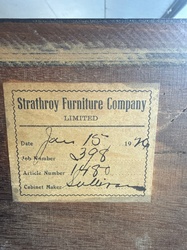
Observable condition details suggest general household use; however, no significant damage, such as large scratches, chips, or repairs, is immediately visible. The finish appears consistent throughout, indicating good maintenance. The style points to a late 20th-century (e.g., 1970s-1990s) traditional or colonial revival period, characterized by its sturdy construction and classic decorative elements. The overall craftsmanship appears solid and functional, aimed at providing display and storage.
Unique aspects include the scalloped sides of the upper shelves and the combination of closed storage in the base with open display above. The brass-toned hardware complements the wood finish, enhancing its traditional appeal.
AI Appraisal Report
Based on my visual examination of the Traditional Wooden China Hutch, I assess its condition as very good, consistent with general household use but without immediate visible significant damage such as deep scratches, chips, or repairs. The finish appears well-maintained and uniform. Authenticity, as a late 20th-century (1970s-1990s) traditional or colonial revival piece, seems assured by its style, construction details like the raised panel doors and bail pull hardware, and overall aesthetic. However, without in-person inspection, I cannot definitively confirm the wood type (solid hardwood vs. veneer over composite) or the construction methods (e.g., joinery), which could slightly impact long-term durability and value.
Market conditions for traditional china hutches are currently moderate. While decorative, their utility and size can limit demand, particularly among younger buyers. Comparables in the resale market suggest that pieces of this period and style typically fetch prices based more on condition and functionality than on intrinsic collector's value or rarity. This hutch is not rare; similar designs were widely produced. Its primary value factors are its solid aesthetic appeal, good condition, and dual functionality for display and storage.
Factors impacting value positively include its appealing traditional design, good state of preservation, and the classic details like the arched upper section, decorative molding, and brass-toned hardware. Negatively, the era of production (late 20th century) generally means a lower value compared to antique pieces, and the sheer volume of similar items on the market prevents significant appreciation. For full authentication and to determine the exact wood species and construction quality, an in-person examination, including inspecting drawers, joints, and internals, would be necessary.