AI estimate as of October 16, 2025 · verify with a professional before acting
AI-Generated · Verify before acting
Everything on this page is generated by AI for informational purposes only. AI can make mistakes — the AI may misidentify items or misattribute them (artist, maker, brand, designer, origin, era). This is not an official valuation and should not be used for insurance, sale, tax, estate, legal, or lending purposes — or any decision requiring a certified appraisal. It is not an authoritative claim about any person, brand, or rights holder — do not share or rely on it as a factual statement about a third party. Always consult qualified professionals before making financial decisions.
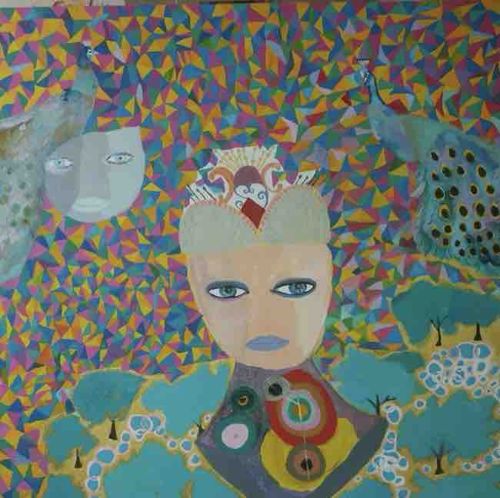
This is a vibrantly colored, abstract figurative painting. The central figure is a stylized human-like face, possibly female, with light skin tone, pronounced blue eyes, and light blue lips. This figure wears a crown or elaborate headpiece that integrates intricate patterns and shapes in colors such as red, off-white, and brown. The torso of the central figure is depicted with a series of concentric and overlapping circular shapes in various colors including red, yellow, pink, and dark grey, suggesting a decorative element or symbolism rather than realistic anatomy. The background is highly abstract, composed of a dense mosaic of small, irregular geometric shapes (predominantly triangles and quadrilaterals) rendered in a wide spectrum of bright colors: yellow, orange, red, pink, blue, green, and purple. This creates a kaleidoscopic and dynamic visual effect throughout the upper and middle portions of the painting. To the left, another large, ghost-like face or mask in a pale grey tone with empty eye sockets and a simple mouth is partially visible. Two peacocks, highly stylized and in shades of blue and green, are positioned on either side of the central figure. Their tail feathers feature the characteristic 'eye' markings, depicted with dark circular spots. The lower section of the painting features more organic, undulating shapes in light blue and yellow, reminiscent of a fantastical landscape with small, dark brown trees. The painting appears to be executed in acrylic or oil on canvas, given the visible brushstrokes and vivid color saturation. There are no obvious signs of significant damage like tears or cracks in the paint layer, and the colors appear well-preserved, indicating good or relatively stable condition. The overall style suggests a modern or contemporary piece, possibly influenced by folk art, surrealism, or geometric abstraction, likely dating from the late 20th century or early 21st century. The craftsmanship involves bold color choices and a clear distinction between the intricate background and the more simplified, prominent foreground figures, indicating a deliberate artistic approach.
AI Appraisal Report
Based on my visual examination of the provided image, this Abstract Figurative Painting with Peacocks appears to be in good, stable condition. The colors are vibrant and well-preserved, suggesting either acrylic or oil on canvas. I observe no overt signs of damage, such as tears, cracks, or significant paint loss. The artistic style, with its bold colors, abstract forms, and surreal elements, points towards a contemporary piece, likely from the late 20th or early 21st century.
From a market perspective, this type of vibrant, decorative abstract art with figurative elements, particularly animal motifs like peacocks, often finds a steady audience. The piece shows deliberate craftsmanship and a unique aesthetic, differentiating it from mass-produced decorative art. Comparable works by lesser-known or emerging contemporary artists in a similar style typically retail in the $800 to $1,500 range, depending on size and exhibition history. While not rare, the distinctiveness of the style could create modest demand among collectors seeking unique, colorful statement pieces.
Factors impacting value include the lack of a discernible artist signature, which prevents attribution and significantly affects higher valuation. Without provenance documentation or a known artist, it's challenging to ascertain the artist's reputation or exhibition history. For full authentication and a more precise valuation, an in-person examination would be crucial to assess surface quality, brushwork subtleties, materials used, and to search for an elusive signature or artist mark. Additionally, provenance documentation detailing the artwork's history of ownership and any exhibition records would be invaluable. Without these, authentication remains limited to visual stylistic analysis.