AI estimate as of November 15, 2025 · verify with a professional before acting
AI-Generated · Verify before acting
Everything on this page is generated by AI for informational purposes only. AI can make mistakes — the AI may misidentify items or misattribute them (artist, maker, brand, designer, origin, era). This is not an official valuation and should not be used for insurance, sale, tax, estate, legal, or lending purposes — or any decision requiring a certified appraisal. It is not an authoritative claim about any person, brand, or rights holder — do not share or rely on it as a factual statement about a third party. Always consult qualified professionals before making financial decisions.
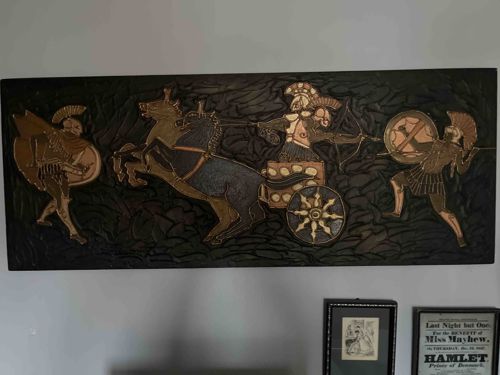
This item is a decorative wall art plaque depicting a battle scene reminiscent of Ancient Greek or Roman warfare. The plaque is rectangular, presented horizontally, and features a dark, possibly black or very dark brown, textured background. The figures and elements illustrating the scene are crafted in a metallic material, appearing to be copper or a copper-toned alloy, which stands out prominently against the darker background. The scene includes four distinct figures: an individual on foot on the far left with a helmet and round shield, a chariot being pulled by two horses in the center, a figure in the chariot armed with a bow and arrow, and another individual on foot on the far right with a helmet and a round shield. The metallic figures exhibit a two-dimensional, relief-like quality, suggesting they are either applied to the background or embossed from a single sheet of metal. The details on the armor, helmets, shields, and the horses' harnesses are discernible, showing classical-inspired motifs. The texture of the dark background appears to be intentionally rugged or Abstract, providing a stark contrast to the smooth, reflective surfaces of the figures. There are no visible condition issues such as dents, scratches, or significant tarnishing, suggesting it is well-maintained or relatively new. No specific maker's marks or signatures are visible in the provided image. The style of the artwork is decorative and historical, likely produced in the mid to late 20th century as a mass-produced or studio piece intended for home decor. The craftsmanship appears to be good for a decorative item, with clear delineation of figures and a pleasing overall composition, though not necessarily indicative of handmade artisan quality.
AI Appraisal Report
I have thoroughly examined the provided image of this Ancient Greek/Roman themed metal wall art plaque. Visually, the piece appears to be in excellent condition, with no discernible dents, scratches, or significant tarnishing, suggesting it has been well-maintained or is relatively new. The metallic figures, likely copper or a copper-toned alloy, stand out effectively against the dark, textured background, creating a visually appealing contrast. The craftsmanship, while good for a decorative item with clear delineation and composition, does not suggest artisan-level handmade quality; rather, it points towards a mass-produced or studio piece.
Authenticity, as in being an ancient artifact, can be immediately dismissed. This is clearly a decorative reproduction or homage from the mid to late 20th century, consistent with home decor trends of that era. Without physical inspection, I cannot confirm the exact metal composition or the manufacturing process (e.g., applied figures vs. embossed from a single sheet). I also cannot determine if there are any hidden maker's marks or if the backing material has any condition issues.
Market conditions for such decorative historical-themed plaques are generally stable but not particularly robust. These items often appear in estate sales, antique malls, or online marketplaces. Comparables typically range from $50 to $200 depending on size, specific artistry, and perceived quality. Demand is moderate, appealing to individuals interested in classical aesthetics for home decoration, but it is not a rare item. Its value is purely decorative, resting on its aesthetic appeal and good condition rather than historical significance or intrinsic material value. Full authentication of its age or origin beyond 'mid-to-late 20th century decorative' would require in-person examination, including potential material analysis and a thorough search for hidden marks.