AI estimate as of July 25, 2025 · verify with a professional before acting
AI-Generated · Verify before acting
Everything on this page is generated by AI for informational purposes only. AI can make mistakes — the AI may misidentify items or misattribute them (artist, maker, brand, designer, origin, era). This is not an official valuation and should not be used for insurance, sale, tax, estate, legal, or lending purposes — or any decision requiring a certified appraisal. It is not an authoritative claim about any person, brand, or rights holder — do not share or rely on it as a factual statement about a third party. Always consult qualified professionals before making financial decisions.
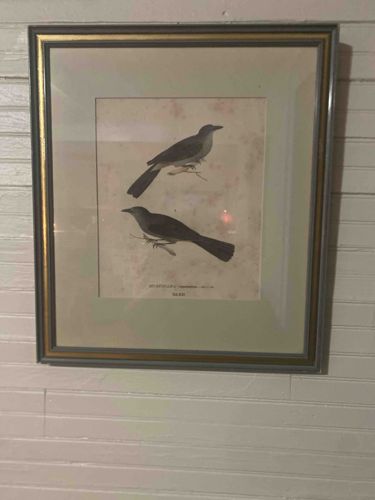
The item is a framed print depicting two birds, likely an ornithological illustration. The birds, identical in appearance, are shown in profile, perched on what appear to be branches. Their plumage is rendered in shades of grey and black, suggesting a monochromatic or limited color palette for the print itself, perhaps an engraving or lithograph. The paper on which the birds are printed exhibits a light, possibly cream or off-white tone, with visible signs of age-related discoloration, particularly a general yellowing and some faint reddish or brownish mottling, which could be foxing or staining. Beneath the lower bird, there is text that is difficult to fully decipher but appears to include scientific names or descriptors, possibly 'MUSCICAPA (MUSCICAPA)....' and 'BLAI'. This suggests an origin from a scientific or natural history publication. The print is matted with a light, possibly off-white or light grey mat board, which shows some slight unevenness or waviness. The frame is rectangular and appears to be made of wood or a composite material, finished with two distinct bands: an inner band of gold or brass color, and an outer band of a darker, possibly grey or dark bronze tone. The frame shows some minor wear consistent with age and handling, but no significant damage is immediately apparent. The overall condition looks stable, though the discoloration of the print paper indicates its age and the need for careful handling. The style points to a historical period, likely pre-20th century, given the illustrative nature and apparent printing technique. The print is housed behind glass.
AI Appraisal Report
Based on my visual examination of the provided image, this framed ornithological print features two identical birds, likely from a scientific or natural history publication. The monochromatic rendering suggests an engraving or lithograph, dating it pre-20th century. The paper shows significant signs of age, including general yellowing and faint reddish/brownish mottling (foxing or staining), indicating a need for careful handling. The indecipherable scientific text below the birds, possibly 'MUSCICAPA (MUSCICAPA)....' and 'BLAI', supports its origin from a scholarly work. The print is matted with an off-white board showing slight waviness, and framed in a two-toned wood or composite frame (inner gold, outer darker tone) with minor wear. Overall condition appears stable despite age-related discoloration.
From images alone, authenticity of the print's age and origin cannot be definitively confirmed. An in-person examination would allow me to assess the paper type, printing technique (e.g., intaglio lines for engraving), watermark presence, and confirm the specific text. Provenance documentation, such as the publication it originated from, would be crucial for full authentication. Scientific testing of paper and ink could further confirm its age.
Market conditions for antique ornithological prints vary widely based on the artist, rarity, condition, and aesthetic appeal. Common prints from less prominent naturalists, especially those with visible foxing and discoloration, typically command lower values. Higher demand exists for well-preserved, finely detailed prints by renowned artists. The apparent commonality of the depicted birds and the visible paper degradation limit its market appeal. This print appears to be a decorative item rather than a rare collector's piece.
Considering the visible discoloration, potential foxing, and the general condition which suggests it's a decorative scientific illustration rather than a fine art print by a famous ornithological artist, I would place its value in the decorative antique print market.