These notes were written by the person who submitted this item. Appraiser.AI has not verified them, and the AI's identification and estimate may rely on them.
AI Estimated Value
Not an official valuation
$450-750
AI estimate as of August 23, 2025 · verify with a professional before acting
AI-Generated · Verify before acting
Everything on this page is generated by AI for informational purposes only. AI can make mistakes — the AI may misidentify items or misattribute them (artist, maker, brand, designer, origin, era). This is not an official valuation and should not be used for insurance, sale, tax, estate, legal, or lending purposes — or any decision requiring a certified appraisal. It is not an authoritative claim about any person, brand, or rights holder — do not share or rely on it as a factual statement about a third party. Always consult qualified professionals before making financial decisions.
This analysis also relies on unverified notes provided by the user, which may be incomplete or inaccurate and could affect the result.
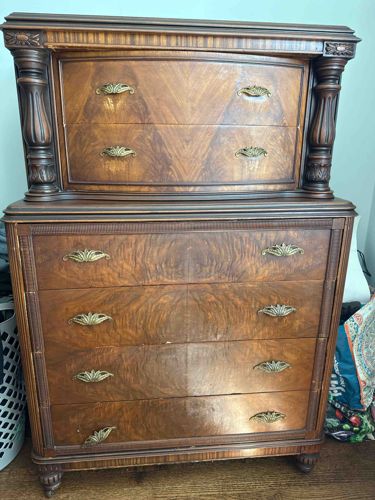
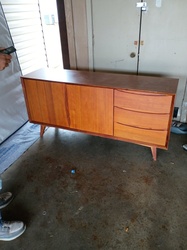
This is a vintage wood dresser, also known as a chest of drawers, featuring a stacked design with an upper section on top of a larger lower section. The wood exhibits a rich, medium-brown finish with distinct swirled and burled grain patterns, likely a veneer over solid wood, indicating a good quality construction. The overall style suggests an Art Deco or early Mid-Century influence, likely manufactured between the 1930s and 1950s. The dresser is adorned with a total of nine brass-colored pulls, intricately designed in a fan or seashell motif, adding a decorative element. The upper section has three drawers, and the lower, larger section contains an additional six drawers, making for ample storage. Notable decorative features include fluted column-like supports on either side of the upper section's drawers, topped with carved acanthus-like or floral embellishments. The top and bottom edges of both sections feature reeded or fluted detailing, adding texture and visual interest. The base of the dresser is supported by four turned, possibly bun or onion style, feet. The condition appears fair to good for its age, with visible signs of wear including some scratches, scuffs, and areas where the finish appears faded or scuffed, particularly on the drawer fronts and edges. One area on the lower central drawer shows a significant scuff mark, and some light white or faded spots are present, suggesting water or heat damage to the finish. The brass pulls show some patina and possible tarnishing consistent with age. Despite the wear, the overall structure seems sound, indicative of solid craftsmanship. The craftsmanship is evident in the detailed carved elements and the matching of the wood veneer patterns, which suggests care in its original production.
AI Appraisal Report
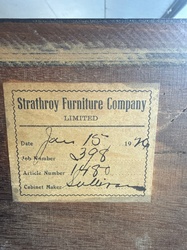
Upon examining the Vintage Stacked Wood Dresser with Brass Pulls, I assess its condition as fair to good for an item of its apparent age, likely dating from the 1930s-1950s. The visible wear, including scratches, scuffs, fading finish, and a significant scuff mark on a lower drawer, are consistent with decades of use. The presence of light white or faded spots suggests possible water or heat damage to the finish. The brass pulls show age-appropriate patina and tarnishing. Authenticity is strongly suggested by the design elements—stacked configuration, intricate fluted and carved details, burled veneer, and period-specific brass pulls—which align well with Art Deco or early Mid-Century styles. However, without in-person examination, I cannot definitively confirm the wood type, construction methods (e.g., joinery), or the precise material of the pulls (brass-colored vs. solid brass). Provenance documentation, such as original sales receipts or manufacturer markings, would also aid in full authentication and dating.
Market conditions for vintage furniture of this style remain relatively stable, with sustained demand for well-constructed, aesthetically pleasing pieces. Comparable sales in the private and auction markets for similar Art Deco/Mid-Century dressers in fair-to-good condition typically range, but the unique stacked design and decorative elements of this piece could enhance its appeal. Factors significantly impacting its value include the current condition, which necessitates restoration for optimal display, and its inherent decorative quality. Rarity is moderate; while stacked dressers are not exceptionally rare, this specific combination of design elements and carved details makes it a distinctive piece. An in-person inspection would allow me to thoroughly assess structural integrity, the extent of finish damage, and the quality of the veneer and underlying wood, all of which would refine this appraisal.