AI Appraisal Estimate

AI-generated estimates · not official valuations

From the user

What was submitted

Photo and notes provided by the user — not generated by AI

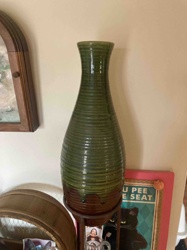
Submitted item photo
Submitted photo · June 26, 2026

User's notes

No additional notes provided.

AI analysis below

AI appraisal

AI analysis & estimate

AI-Generated · Verify before acting

Everything below is generated by AI for informational purposes only. AI can make mistakes — the AI may misidentify items or misattribute them (artist, maker, brand, designer, origin, era). This is not an official valuation and should not be used for insurance, sale, tax, estate, legal, or lending purposes — or any decision requiring a certified appraisal. It is not an authoritative claim about any person, brand, or rights holder — do not share or rely on it as a factual statement about a third party. Always consult qualified professionals before making financial decisions.

Read the full disclaimer

AI Identification

·Not independently authenticated·Verify before acting

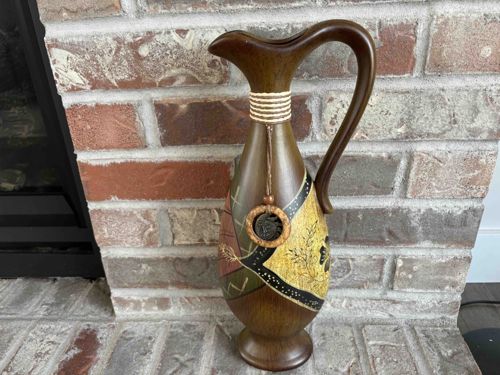
Mid-Century Modern Style Decorative Ceramic Ewer Pitcher

Home Decor / Art Pottery

AI Estimated Value

·Not an official valuation·Verify before acting

$45.00 - $75.00

As of June 26, 2026

AI Item Analysis

·AI can make mistakes·Verify before acting
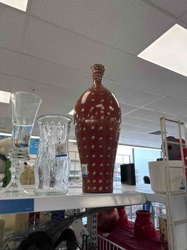
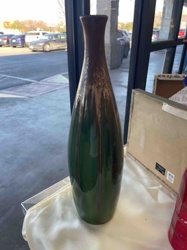
This item is a tall, decorative ceramic ewer or pitcher featuring a slender, elongated neck and a high-arching handle characteristic of Mid-Century Modern silhouettes. The body is finished in a warm, dark wood-grain glaze that mimics the appearance of polished mahogany or walnut. Its bulbous midsection is decorated with hand-painted or transfer-applied geometric and floral panels in shades of ochre, sage green, and muted red, accented by black borders with white stippling. Around the narrow neck, a decorative white cord or wicker-style wrap adds tactile interest. Hanging from this wrap is a unique mixed-media charm consisting of a dark string, a wooden bead, and a circular wooden pendant containing a metallic-looking medallion with a profile relief. The piece sits on a flared, circular pedestal base. The overall construction appears to be molded ceramic with a matte to semi-gloss finish. Based on the stylistic elements and the 'wood-grain' ceramic technique, this piece likely dates from the late 20th century, drawing inspiration from high-end Danish modern or Italian Brutalist designs of the 1960s. The condition appears to be excellent vintage quality with no visible chips, cracks, or crazing, though light surface dust suggests it has been used as a stationary decor element for some time.
AI Appraisal Report

·AI can make mistakes·Verify before acting
I have conducted a visual examination of the Mid-Century Modern style decorative ceramic ewer. The piece exhibits a faux-bois glaze technique intended to simulate teak or mahogany, a popular aesthetic in the late 20th-century revival of Danish Modern design. The condition appears Excellent; I observe no visible crazing, kiln flaws, or post-production damage to the spout or base. The mixed-media cord and wooden medallion are intact, which is rare as these fugitive elements are often lost over time. While the silhouette draws from 1960s Italian Brutalist and Scandinavian forms, the specific glaze application and the nature of the cord wrap suggest this is a high-quality decorative import rather than a signed studio piece. Current market data for unsigned MCM-revival ceramics shows steady demand among interior decorators, though they lack the high-ceiling value of authenticated Bitossi or Royal Copenhagen works. The value is driven primarily by its aesthetic utility and retro-chic appeal. A significant limitation of this remote appraisal is the inability to inspect the underside for maker's marks, incised signatures, or 'Made in' stamps often hidden by the pedestal base. To definitively authenticate this as a specific designer piece, I would require high-resolution photography of the base and any provenance documentation. Furthermore, physical inspection is necessary to confirm the absence of professional repairs or internal structural cracks that are not discernible from a standard photographic view. Scientific testing of the clay body could determine geographic origin, though the cost would likely exceed the item's current market value.

Get your items appraised

Instant estimates of your treasures with AI-powered appraisals

Browse More Appraisals