AI estimate as of December 1, 2025 · verify with a professional before acting
AI-Generated · Verify before acting
Everything on this page is generated by AI for informational purposes only. AI can make mistakes — the AI may misidentify items or misattribute them (artist, maker, brand, designer, origin, era). This is not an official valuation and should not be used for insurance, sale, tax, estate, legal, or lending purposes — or any decision requiring a certified appraisal. It is not an authoritative claim about any person, brand, or rights holder — do not share or rely on it as a factual statement about a third party. Always consult qualified professionals before making financial decisions.
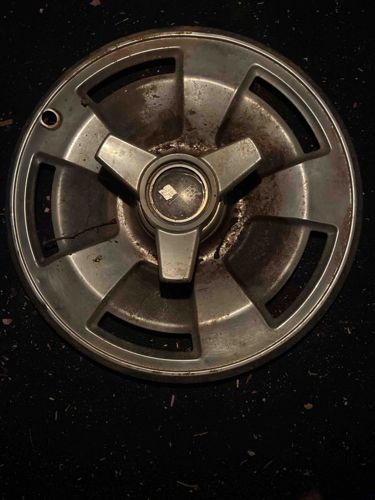
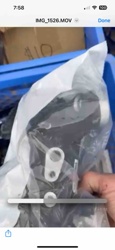
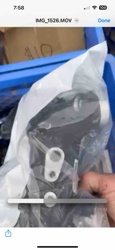
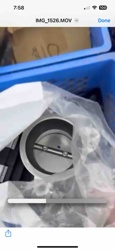
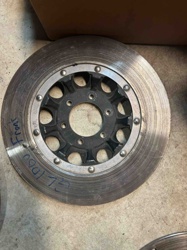
This is a vintage automotive hubcap, likely an aftermarket accessory due to its somewhat generic yet stylish design. It is constructed from a metallic material, possibly chrome-plated steel or aluminum, with a silver-gray finish. The hubcap features a multi-spoke design, specifically six spokes, each with an elongated, rectangular opening near the rim which adds a sporty aesthetic. Six larger, solid spokes radiate from the central hub, creating a structured, almost turbine-like appearance. The overall shape is circular with a raised central cap. In the very center, there is a round emblem with a faded or worn graphic that appears to be a stylized "S" or a similar diamond-shaped crest, although it is not clearly identifiable as a specific manufacturer's logo. The surface exhibits significant wear and tear consistent with age and prolonged outdoor exposure. There are numerous areas of rust, particularly in the recessed sections and along the edges of the spokes, indicating that the finish has deteriorated. Scratches, scuffs, and abrasions are visible across the entire surface. A notable condition issue is a clear crack or split extending from the central hub towards one of the spokes, suggesting impact damage or material fatigue. A small circular hole, possibly for a valve stem or a mounting clip, is located near the outer edge in one of the recessed areas. The edges show some minor bending or deformation. The item appears to be from the 1970s or 1980s, given the characteristic design often seen in aftermarket performance or style upgrades from that era. Its craftsmanship is functional, but the current condition indicates a lack of maintenance over its lifespan. The presence of rust and the visible crack significantly reduce its aesthetic appeal and structural integrity.
AI Appraisal Report
I have carefully examined the provided image of this vintage aftermarket automotive hubcap. The item, likely from the 1970s or 80s, displays significant wear and tear. Its multi-spoke, visually sporty design suggests an aftermarket accessory rather than an OEM part. The primary material appears to be chrome-plated steel or aluminum, now extensively marred by rust, scratches, and abrasions across its silver-gray finish. A critical condition issue is a clear crack extending from the central hub, indicating structural compromise and potential impact damage. The faded central emblem, possibly a stylized 'S' or crest, is not clearly identifiable, limiting specific brand association.
Given its generic aftermarket nature and severe condition, including rust, deep scratches, and a structural crack, the market for this single hubcap is extremely limited. There is little demand for a damaged, non-matching aftermarket hubcap of this type, as collectors typically seek complete sets or pristine individual pieces for restoration. Comparables in similar poor condition fetch very low prices, often only for scrap metal if not for the slight possibility that someone might need it for a very low-budget, period-correct restoration where cosmetic defects are acceptable.
Factors significantly impacting its value are the extensive rust, the structural crack, and its status as a single, generic aftermarket item. Without a clear manufacturer's mark, it lacks specific collectible appeal.
Limitations to authenticity verification from images alone include the inability to fully assess the extent of material fatigue, the depth of the crack, or the exact composition of the metal. An in-person examination would allow for precise measurement of the crack, assessment of the true depth of rust and pitting, and potential identification of the emblem through closer inspection. Provenance documentation could potentially link it to a specific vehicle or manufacturer, but that's highly unlikely for such an item. Scientific testing (e.g., spectroscopy) would be needed to determine the exact metal composition and plating, though this is not typically pursued for items of this low value.