These notes were written by the person who submitted this item. Appraiser.AI has not verified them, and the AI's identification and estimate may rely on them.
AI Estimated Value
Not an official valuation
$25-45
AI estimate as of July 17, 2025 · verify with a professional before acting
AI-Generated · Verify before acting
Everything on this page is generated by AI for informational purposes only. AI can make mistakes — the AI may misidentify items or misattribute them (artist, maker, brand, designer, origin, era). This is not an official valuation and should not be used for insurance, sale, tax, estate, legal, or lending purposes — or any decision requiring a certified appraisal. It is not an authoritative claim about any person, brand, or rights holder — do not share or rely on it as a factual statement about a third party. Always consult qualified professionals before making financial decisions.
This analysis also relies on unverified notes provided by the user, which may be incomplete or inaccurate and could affect the result.
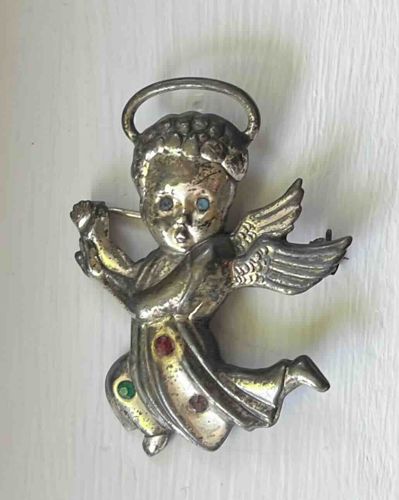
This item is a vintage angel- or cherub-shaped brooch, approximately 1.5 inches in height, crafted from a silver-toned metal, likely a base metal alloy with a silver plating or rhodium finish, given the visible wear. The design depicts a winged baby angel or cherub in a dynamic, playful pose, holding what appears to be a small musical instrument, possibly a flute or horn, to its mouth. The figure has a halo above its head and prominent, detailed wings spread to the side. The angel's eyes are represented by small, light blue, possibly glass or rhinestone, accents. The lower part of the angel's robe or drapery is adorned with three round, prong-set 'jewels' or rhinestones: one green, one amber/brown, and one red, adding a touch of color. The overall construction suggests a cast or stamped metal body.
Condition-wise, the brooch exhibits significant wear consistent with its age and use. There is noticeable loss of the silver-toned finish, revealing a darker metal underneath, particularly on raised areas such as the halo, hair, nose, and edges of the wings and drapery. This wear contributes to an aged patina. No specific maker's marks or signatures are visible in the provided image. The pin mechanism on the back, though not fully visible, appears to be a standard hinged pin and catch, indicating its function as a brooch. The style, with its playful cherubic figure and use of colorful rhinestones, suggests it could date from the mid-20th century, possibly the 1940s to 1960s, reflecting a popular aesthetic of sentimental or decorative figural jewelry from that era. The craftsmanship is decent for an item of its likely mass-produced or costume jewelry nature, showing good sculptural detail but with visible signs of aging.
AI Appraisal Report
Upon examining the provided image and description of this vintage angel/cherub figural brooch, I find it to be a charming example of mid-20th century costume jewelry. The approximate 1.5-inch height and silver-toned base metal construction, likely plated, align with common manufacturing practices of the era. The design, featuring a winged cherub with a halo, musical instrument, and colorful rhinestone accents (green, amber, red), is consistent with popular sentimental or decorative themes.
The condition, as described and visible, shows significant wear to the silver-toned finish, revealing a darker base metal underneath. This is typical for older plated costume jewelry that has been worn and cherished. While this wear contributes to an aged patina, it does detract from the original pristine appearance. The absence of visible maker's marks is common for many mass-produced costume jewelry pieces of this period.
In terms of market conditions, vintage figural brooches, particularly those with charming themes like cherubs, maintain a steady, albeit modest, demand among collectors of costume jewelry. Comparables in this condition, without notable designer attribution or precious materials, typically sell in the lower range of vintage collectibles. While not rare, the unique design elements offer some appeal. The primary factors impacting its value are the base metal construction, the notable finish loss, and the lack of a known maker. Authenticity verification based solely on images is limited; I can confirm it appears consistent with period costume jewelry. Full authentication might require in-person examination to verify metal composition, setting integrity, and thoroughly search for any hidden marks under magnification.