AI estimate as of July 10, 2025 · verify with a professional before acting
AI-Generated · Verify before acting
Everything on this page is generated by AI for informational purposes only. AI can make mistakes — the AI may misidentify items or misattribute them (artist, maker, brand, designer, origin, era). This is not an official valuation and should not be used for insurance, sale, tax, estate, legal, or lending purposes — or any decision requiring a certified appraisal. It is not an authoritative claim about any person, brand, or rights holder — do not share or rely on it as a factual statement about a third party. Always consult qualified professionals before making financial decisions.
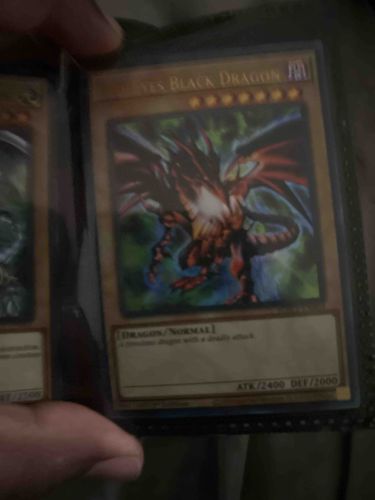
The item is a Yu-Gi-Oh! trading card, specifically identified as 'Red-Eyes Black Dragon' (or 'Red Eyes Black Dragon' based on the visible text). It features a prominent illustration of a dark-colored dragon with red accents, particularly on its wings and possibly its eyes, set against a dark green and blue background with ethereal, smoky elements. The card appears to be housed within a clear plastic protective sleeve, which is typical for collectible trading cards to preserve their condition. The visible portion of the card shows a gold-colored frame, indicating a Monster Card type, likely a Normal Monster given the 'NORMAL' text visible in the description box. At the top of the card, the name 'RED-EYES BLACK DRAGON' is clearly legible, alongside six orange stars, signifying its Level as 7. To the right of the name, there is a distinct purple attribute symbol, which in Yu-Gi-Oh! represents the DARK attribute. Below the illustration, a text box contains the card's Type/Ability: 'DRAGON/NORMAL]' with a short description 'A ferocious dragon with a deadly attack.' At the bottom right corner of this text box, the Attack (ATK) and Defense (DEF) stats are visible, displaying 'ATK/2400 DEF/2000'. The card's overall condition appears good, with no obvious major creases, tears, or significant surface wear visible through the sleeve, though minor imperfections might be obscured. The colors are vibrant, and the print quality seems high. It is part of a larger collection stored in what appears to be a binder or card album. Given its properties (Level 7, 2400 ATK, 2000 DEF, Dragon/Normal type, DARK attribute), this is a classic and iconic Yu-Gi-Oh! monster card, dating back to the early eras of the game, likely from the late 1990s to early 2000s, or a reprint from a later set. The craftsmanship is consistent with officially licensed Konami Yu-Gi-Oh! trading card products.
AI Appraisal Report
Upon my examination of the Yu-Gi-Oh! Red-Eyes Black Dragon card, I observe it to be housed within a protective sleeve, which has seemingly preserved its condition well. The card exhibits vibrant colors and sharp printing, with no apparent major creases, tears, or significant surface wear visible through the plastic. The gold framing, 'DARK' attribute, 'Level 7', 'DRAGON/NORMAL' type, and 'ATK/2400 DEF/2000' stats align perfectly with authentic Red-Eyes Black Dragon cards. However, I must state that verifying the card's specific set, print run, and holofoil rarity (e.g., 'Starter Deck Yugi', 'LOB', 'Metal Raiders', or a later reprint) is impossible from images alone. This greatly impacts its market value. The most desirable versions are early printings, particularly a '1st Edition' or 'Secret Rare' from classic sets, due to their scarcity and historical significance. Demand for iconic cards like Red-Eyes remains consistently high among collectors and players. Market comparables for well-preserved, authentic early prints can range significantly based on their specific set, edition, and certified grade. Without physical inspection, I cannot ascertain subtle surface imperfections, corner wear, specific print nuances, or the card's precise rarity (e.g., common, super, ultra, secret rare) which are critical for an accurate valuation. Full authentication would require in-person examination to verify print lines, texture, holofoil patterns, and potentially third-party grading by services like PSA or Beckett to confirm condition and authenticity unequivocally.