AI Appraisal Estimate

AI-generated estimates · not official valuations

From the user

What was submitted

Photo and notes provided by the user — not generated by AI

Submitted item photo
Submitted photo · May 30, 2026

User's notes

No additional notes provided.

AI analysis below

AI appraisal

AI analysis & estimate

AI-Generated · Verify before acting

Everything below is generated by AI for informational purposes only. AI can make mistakes — the AI may misidentify items or misattribute them (artist, maker, brand, designer, origin, era). This is not an official valuation and should not be used for insurance, sale, tax, estate, legal, or lending purposes — or any decision requiring a certified appraisal. It is not an authoritative claim about any person, brand, or rights holder — do not share or rely on it as a factual statement about a third party. Always consult qualified professionals before making financial decisions.

Read the full disclaimer

AI Identification

·Not independently authenticated·Verify before acting

Vintage Porcelain Footed Trinket Dish with Peach Lustre Finish

Vintage Decorative Porcelain & Collectible Ceramics

AI Estimated Value

·Not an official valuation·Verify before acting

$15.00 - $25.00

As of May 30, 2026

AI Item Analysis

·AI can make mistakes·Verify before acting
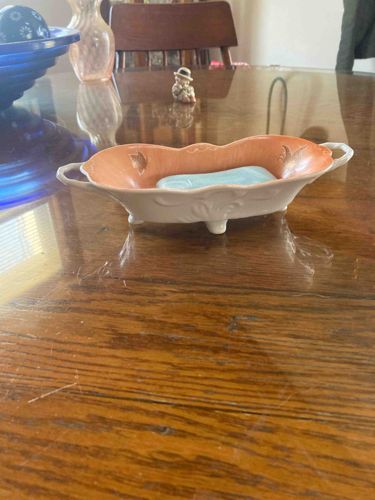
This item is a small, elongated porcelain trinket dish or nut bowl, characterized by its elegant footed base and twin open-work handles. The exterior of the vessel is finished in a smooth, matte white glaze, featuring low-relief molded scrollwork and floral motifs that suggest a late Victorian or early 20th-century Art Nouveau influence. The interior of the dish provides a striking contrast, coated in a bright orange or peach-colored 'lustre' glaze that possesses an iridescent, metallic quality typical of mid-century Japanese or German import porcelain. Centrally placed within the bowl is a raised, light-blue molded element, possibly intended to resemble a bar of soap or a decorative pad, signifying its potential use as a vanity or dresser top accessory. The vessel rests on four small, tapered peg feet, which appear to be integral to the mold. There are subtle gold-tone accents or 'gilding' visible on the interior rim and within the floral reliefs, though some fading of these metallic highlights is evident. The condition appears fair to good; there are no immediate signs of large chips or cracks visible from this angle, though the lustre finish shows some minor surface wear and oxidation consistent with age. This style was popularized between the 1920s and 1950s, often produced as 'occupational' or export ware.
AI Appraisal Report

·AI can make mistakes·Verify before acting
I have virtually examined this porcelain trinket dish, which displays the stylistic markers of mid-20th-century Japanese 'Lustreware' export. The combination of the matte bisque exterior, relief-molded rococo scrolls, and the metallic peach iridescence (achieved via a thin metallic film over a glaze) is characteristic of the 'Made in Japan' or 'Occupied Japan' era (late 1940s-1950s). The central blue raised element suggests a specific utilitarian function as a soap dish or vanity tray. Direct visual inspection indicates the item is in fair to good condition. There is noticeable thinning of the gold-leaf accents along the rim and wear on the iridescent interior, common for these decorative coatings which are susceptible to oxidation and cleaning abrasions. The rarity of this item is low; these were mass-produced for the giftware market. Market demand currently favors mid-century modern minimalism over this ornate export style, leading to a saturated market of similar 'occupational' ceramics. Authenticity of the style is apparent, but a definitive valuation is limited by the digital format. I cannot inspect for micro-fractures, nor can I verify the presence of a maker's mark on the base, which is crucial for determining if it is 'Occupied Japan' ware (which commands a slight premium). In-person examination is required to verify the integrity of the feet and ensure no professional restorations have occurred. Full authentication would necessitate viewing the underside markings and checking for porcelain density to distinguish it from lower-quality earthenware imitations.

Get your items appraised

Instant estimates of your treasures with AI-powered appraisals

Browse More Appraisals