These notes were written by the person who submitted this item. Appraiser.AI has not verified them, and the AI's identification and estimate may rely on them.
AI Estimated Value
Not an official valuation
$2,500 - $4,000
AI estimate as of August 31, 2025 · verify with a professional before acting
AI-Generated · Verify before acting
Everything on this page is generated by AI for informational purposes only. AI can make mistakes — the AI may misidentify items or misattribute them (artist, maker, brand, designer, origin, era). This is not an official valuation and should not be used for insurance, sale, tax, estate, legal, or lending purposes — or any decision requiring a certified appraisal. It is not an authoritative claim about any person, brand, or rights holder — do not share or rely on it as a factual statement about a third party. Always consult qualified professionals before making financial decisions.
This analysis also relies on unverified notes provided by the user, which may be incomplete or inaccurate and could affect the result.
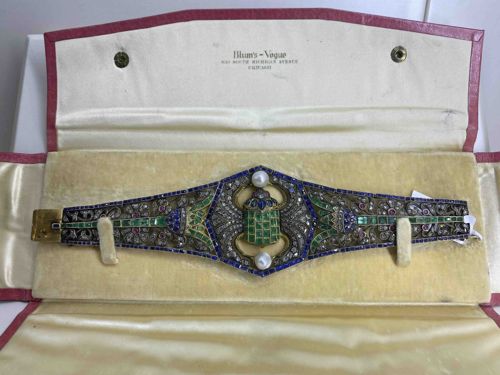
This is an exquisite Art Deco-era dress clip or brooch, likely dating from the 1920s, presented in its original retail box. The piece features an elaborate design, heavily encrusted with various gemstones and enamel work. Its central motif appears to be a stylized lantern or geometric cage-like structure, rendered in green enamel with what appear to be small diamond accents, flanked by two prominent pearl drops. The main body of the clip is a tapered, shield-like shape, symmetrical on both sides, with intricate scrollwork and floral patterns executed in pave-set diamonds (or diamond simulants) and vibrant blue enamel. Along the tapered sections, there are rectangular-cut green gemstones, possibly emeralds, interspersed with smaller red stones, likely rubies or garnets, and additional diamonds set in ornate patterns. The metal setting appears to be silver or platinum, given the oxidation visible on some surfaces, lending to a blackened patina in areas, which is typical for older silver-set diamond jewelry. The craftsmanship is highly detailed, showcasing significant handiwork in the stone setting and enameling, indicative of high-quality period jewelry. The piece is housed in its original red leatherette hinged case with a cream-colored satin interior and velvet fitted insert. The lid of the case bears the mark "Blum's - Vogue" and "Oak Street- Michigan Ave.", "Chicago", indicating the original upscale retailer. This suggests the piece was retailed by a prominent luxury boutique, hinting at its provenance and inherent quality. The overall condition appears to be good for its age, though some light wear and minor tarnish are visible, consistent with a vintage item. The clasp mechanism, visible on the left side, is a typical articulated bar and pin closure for a brooch or clip, made of a contrasting gold-tone metal, likely brass or gold-filled.
AI Appraisal Report
Based on my visual examination of the provided image, this Art Deco Gemstone and Enamel Shield Dress Clip/Brooch is a striking example of period jewelry, likely from the 1920s. Its condition appears good overall for its age, exhibiting typical minor wear and tarnish consistent with a vintage item. The original Blum's - Vogue retail box significantly enhances its authenticity and provenance. The intricate design, featuring what appear to be pave-set diamonds (or high-quality simulants), vibrant blue and green enamel, and colored gemstones (likely emeralds, rubies/garnets, and pearls), speaks to high-quality craftsmanship characteristic of the era. The presence of the original retailer's mark, 'Blum's - Vogue, Oak Street - Michigan Ave., Chicago,' firmly establishes its provenance from a reputable luxury boutique, adding to its desirability and value.
Market demand for authentic Art Deco jewelry, especially pieces with clear provenance and original packaging, remains strong. Comparable items of this quality, particularly those with genuine gemstones and intricate enameling, fetch significant prices. The unique design and potential for high-quality gemstones contribute to its rarity. Factors positively impacting value include the Art Deco period popularity, the comprehensive use of materials, and the original box.
My primary limitation is the lack of physical examination. While the stones appear to be genuine, only in-person inspection and scientific testing (e.g., specific gravity, refractive index, microscopy) can confirm stone identity (diamonds vs. simulants, specific colored gemstones) and natural vs. synthetic origin. A close examination of the metal would confirm if it's platinum or silver and assess the integrity of the enamel. Without this, the appraisal assumes genuine, period-appropriate materials commensurate with Blum's - Vogue quality.