AI Appraisal Estimate

AI-generated estimates · not official valuations

From the user

What was submitted

Photo and notes provided by the user — not generated by AI

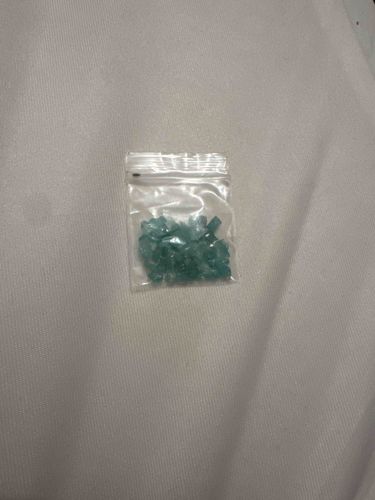
Submitted item photo
Submitted photo · June 6, 2026

User's notes

Pure Emerald

AI analysis below

AI appraisal

AI analysis & estimate

AI-Generated · Verify before acting

Everything below is generated by AI for informational purposes only. AI can make mistakes — the AI may misidentify items or misattribute them (artist, maker, brand, designer, origin, era). This is not an official valuation and should not be used for insurance, sale, tax, estate, legal, or lending purposes — or any decision requiring a certified appraisal. It is not an authoritative claim about any person, brand, or rights holder — do not share or rely on it as a factual statement about a third party. Always consult qualified professionals before making financial decisions.

Note

This analysis also relies on unverified notes provided by the user, which may be incomplete or inaccurate and could affect the result.

Read the full disclaimer

AI Identification

·Not independently authenticated·Verify before acting

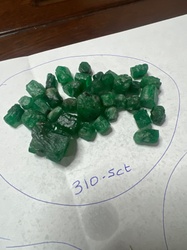
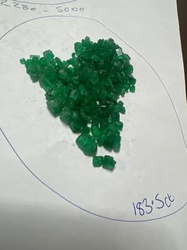
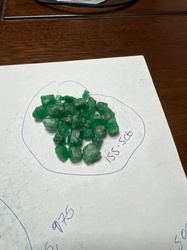
Rough Natural Emerald Crystals

Gemstones & Minerals

AI Estimated Value

·Not an official valuation·Verify before acting

$450.00 - $650.00

As of June 6, 2026

AI Item Analysis

·AI can make mistakes·Verify before acting
This item consists of a collection of small, rough natural emerald crystals, presented in a clear plastic resealable specimen bag. The gemstones exhibit a characteristic vibrant bluish-green to grass-green hue, indicative of high chromium or vanadium content typically found in beryl. The crystals are uncut and unpolished, maintaining their natural hexagonal prismatic growth structures which are characteristic of emerald formations. They vary in size, generally appearing to be under 1 centimeter in length, and vary in clarity from translucent to near-transparent. Close observation reveals internal inclusions, often referred to as 'jardin' (garden) in the gemological world, which are standard for natural emeralds and help distinguish them from synthetic counterparts. There are no visible signs of synthetic coating or dye, though rough stones at this stage are typically evaluated for oil treatment potential. The stones appear to be in their raw, mined state with minor surface abrasions and natural fracture lines common to this brittle gemstone. Without a specific mine origin certificate, the color saturation suggests potential origins such as Colombia, Zambia, or Brazil. The overall quality appears consistent with higher-grade specimen material suitable for faceting, tumbling, or use in 'raw' jewelry designs.
AI Appraisal Report

·AI can make mistakes·Verify before acting
I have conducted a visual examination of the rough natural emerald crystals described. The specimens exhibit the classic hexagonal prismatic habit and the deep 'grass-green' saturation associated with high-quality beryl. The Presence of internal 'jardin' inclusions suggests a natural origin rather than synthetic production. At an estimated total weight of 15-20 carats for the parcel, the color density is quite desirable for high-end specimen collectors or 'raw' jewelry artisans. The current market for rough emeralds remains strong, specifically for material with high transparency. However, as these are uncut, their final value is contingent upon their yield after faceting or polishing. Comparable parcels of similar saturation and size from Colombian or Zambian mines currently trade in the $25-$40 per carat range for specimen-grade rough. The primary value drivers here are the intensity of the green hue and the structural integrity of the prisms. A significant limitation of this appraisal is the inability to perform a refractive index test or microscopic analysis via digital images. Without physical inspection, I cannot confirm if the stones have undergone significant clarity enhancement with oils (common in rough stock) or if they are glass-filled. Furthermore, determining the specific geographic origin—which can fluctuate value by 30% or more—is impossible without a trace element analysis. To finalize this valuation, I recommend an in-person gemological inspection and a certificate from a recognized laboratory such as the GIA or GRS to verify the absence of artificial dyes and the exact treatment level.

Get your items appraised

Instant estimates of your treasures with AI-powered appraisals

Browse More Appraisals