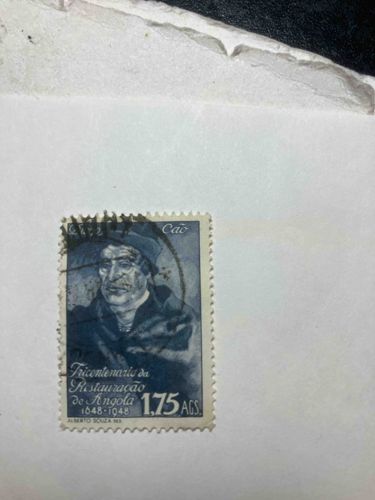
1948 Angola Diogo Cão 1,75 AGS Tricentenary of the Restoration Stamp
This is a single used postage stamp issued in 1948 for the Portuguese colony of Angola. The stamp commemorates the 'Tricantenário da Restauração de Angola' (Tricentenary of the Restoration of Angola, 1648–1948). It features an artistic blue-monotone portrait of the Portuguese explorer Diogo Cão, based on a design by artist Alberto Souza, as indicated by the 'ALBERTO SOUZA DES.' credit at the bottom left. The denomination is clearly marked as '1,75 AGS' (Angolares). Physically, the stamp is a vertical rectangle with standard perforations. It is printed on light-colored paper and has been canceled with a black ink postmark that is visible over the top-left quadrant of the portrait. The condition appears fair to good for a used specimen; while the perforations seem mostly intact, there is some minor toning or yellowing consistent with age (patina) visible on the paper. There are no immediate signs of significant tearing or creases, though the cancellation mark obscures some of the fine engraving detail in the upper portion of the face. The craftsmanship represents mid-20th-century colonial philatelic design, characterized by detailed line engraving and a formal historical layout.
AI-Generated Appraisal Disclaimer
Estimated Value
$0.50 - $1.50
Basic Information
Category
Philately / Collectible Postage Stamps
Appraised On
January 27, 2026
Estimated Value
$0.50 - $1.50
Item Description
This is a single used postage stamp issued in 1948 for the Portuguese colony of Angola. The stamp commemorates the 'Tricantenário da Restauração de Angola' (Tricentenary of the Restoration of Angola, 1648–1948). It features an artistic blue-monotone portrait of the Portuguese explorer Diogo Cão, based on a design by artist Alberto Souza, as indicated by the 'ALBERTO SOUZA DES.' credit at the bottom left. The denomination is clearly marked as '1,75 AGS' (Angolares). Physically, the stamp is a vertical rectangle with standard perforations. It is printed on light-colored paper and has been canceled with a black ink postmark that is visible over the top-left quadrant of the portrait. The condition appears fair to good for a used specimen; while the perforations seem mostly intact, there is some minor toning or yellowing consistent with age (patina) visible on the paper. There are no immediate signs of significant tearing or creases, though the cancellation mark obscures some of the fine engraving detail in the upper portion of the face. The craftsmanship represents mid-20th-century colonial philatelic design, characterized by detailed line engraving and a formal historical layout.

Related Tags
Get Your Items Appraised
Instant estimates of your treasures with AI-powered instant appraisals