AI estimate as of October 22, 2025 · verify with a professional before acting
AI-Generated · Verify before acting
Everything on this page is generated by AI for informational purposes only. AI can make mistakes — the AI may misidentify items or misattribute them (artist, maker, brand, designer, origin, era). This is not an official valuation and should not be used for insurance, sale, tax, estate, legal, or lending purposes — or any decision requiring a certified appraisal. It is not an authoritative claim about any person, brand, or rights holder — do not share or rely on it as a factual statement about a third party. Always consult qualified professionals before making financial decisions.
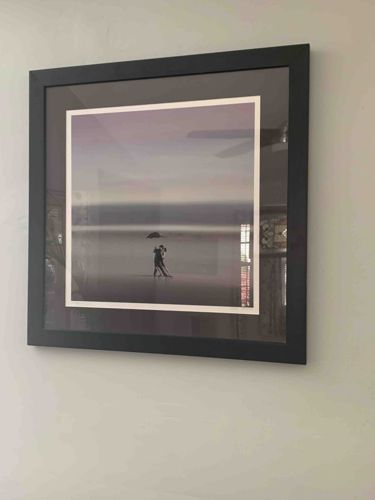
This item is a framed photographic print depicting a minimalist seascape scene with two figures. The photograph itself features a wide-angle view of what appears to be a beach or a very shallow body of water under a muted, possibly dawn or dusk, sky. The sky transitions from a faint pinkish-purple at the top to a light blue and then a prominent horizontal band of white and grey across the middle, suggesting a horizon line where the sky meets water or mist. The lower portion of the image is a darker greyish-brown, representing wet sand or shallow water. In the center-lower half of the photograph, two silhouetted figures are visible, seemingly standing close together. One figure appears to be holding an umbrella, though details are indistinct due to the silhouetted nature. The overall mood is serene and somewhat melancholic. The print is housed within a contemporary black wooden frame with a clean, flat profile. A wide, white mat board surrounds the photograph, providing a significant border that isolates the central image and enhances its visual impact. The glass covering the print shows some reflections, indicating a glossy finish and suggesting it is a standard glass or acrylic glazing. The frame appears to be in excellent condition with no visible chips, scratches, or wear. The mat also looks clean and free of discoloration. The print itself shows no obvious signs of fading or damage. The piece is indicative of modern decorative art, likely from the late 20th or early 21st century, designed for contemporary interior spaces. The craftsmanship of the framing appears to be of good quality, with tight mitered corners and a consistent finish.
AI Appraisal Report
I have examined the provided image of the framed photographic print, 'Couple with Umbrella on a Seashore.' Based on this visual inspection, the item appears to be in excellent condition. The frame shows no visible damage, the mat is clean and free from discoloration, and the print itself exhibits no apparent fading or damage. The craftsmanship of the framing seems of good quality with tight mitered corners.
This piece falls into the category of modern decorative art, likely produced for contemporary interior design. The serene, minimalist aesthetic with silhouetted figures is a popular and widely available style in mass-produced and decorative art markets. While aesthetically pleasing, there is no indication from the image alone that this is a limited edition print, a work by a notable photographer, or a vintage piece with historical significance. The presence of reflections on the glass suggests standard glazing, not museum quality.
Considering current market conditions for decorative photographic prints of this nature, comparable items from unknown or emerging artists, often found in retail stores specializing in home decor or online marketplaces, typically range in price. The value is primarily driven by its decorative appeal and excellent condition, rather than the intrinsic artistic value or rarity.
Limitations: My assessment of condition and authenticity is based solely on the provided image. Without a physical inspection, it is impossible to verify the print's medium (e.g., archival paper, type of printing process), the quality of the glass (e.g., UV protection), or the exact nature of the print (e.g., an original photograph versus a reproduction). In-person examination would be required to look for artist signatures, edition numbers, or any labels on the reverse that could provide provenance. Scientific testing, such as dating techniques for the paper or ink, would be necessary for full authentication if it were presented as a vintage or artist-signed piece, neither of which is suggested here.