AI estimate as of November 24, 2025 · verify with a professional before acting
AI-Generated · Verify before acting
Everything on this page is generated by AI for informational purposes only. AI can make mistakes — the AI may misidentify items or misattribute them (artist, maker, brand, designer, origin, era). This is not an official valuation and should not be used for insurance, sale, tax, estate, legal, or lending purposes — or any decision requiring a certified appraisal. It is not an authoritative claim about any person, brand, or rights holder — do not share or rely on it as a factual statement about a third party. Always consult qualified professionals before making financial decisions.
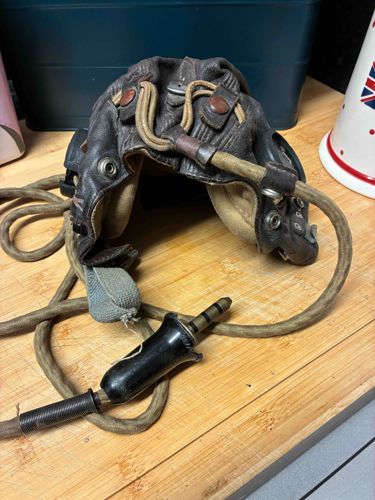
This item is a vintage pilot's leather flight helmet, likely dating from the mid-20th century, possibly World War II era or slightly later. The helmet is constructed primarily from dark brown or black weathered leather, showing significant signs of age and use. The exterior leather is wrinkled and scuffed in various places, indicating a rich patina acquired over decades. The interior appears to be lined with a lighter, possibly tan or beige, fabric or soft leather material. Integrated into the helmet is a wired headset system. Earphone cavities are evident on both sides, featuring metal grommets and possibly containing internal components (not visible). A prominent feature is the microphone boom, which consists of a rigid, curved, light-brown colored tube, possibly plastic or hard rubber, attached to the side of the helmet. The boom's attachment point is secured with dark brown leather straps and metal fasteners. A fabric-covered electrical cord, also light brown or olive drab, extends from the helmet, intricately woven and secured to various points with small leather loops and stitching. This cord leads to a large, black, multi-pronged audio jack, which appears to be of an earlier standard, possibly a 1/4 inch or similar gauge, designed for historical radio or intercommunication systems. Near the jack, a spring-like strain relief is visible on the cord, and a small, light-colored fabric-wrapped component (possibly a switch or small junction box) is also attached to the cord further up. The overall craftsmanship suggests a utilitarian military or aviation-grade item, built for durability and function rather than aesthetics. There's visible fraying on some of the fabric elements and general wear consistent with its age and intended use in harsh environments. The metal components show some oxidation. No discernible maker's marks or specific model numbers are visible in the provided images.
AI Appraisal Report
Based on my visual examination of the provided image, this vintage pilot's leather flight helmet appears to be an authentic period piece, likely from the mid-20th century, consistent with WWII or immediate post-WWII aviation gear. The dark brown, weathered leather exhibits a rich patina, wrinkles, and scuffs, all indicative of genuine age and use, not artificial distressing. The integrated wired headset, prominent microphone boom, and fabric-covered electrical cord terminating in a large, multi-pronged audio jack further support its authenticity as functional flight equipment from that era. The overall utilitarian craftsmanship, visible fraying, and oxidation on metal components align with expected wear for military or aviation-grade items of this vintage.
Market conditions for vintage flight helmets depend heavily on specific model, pilot association, and condition. While this example shows significant wear, its completeness with an intact communication system enhances its appeal to collectors of aviation memorabilia and militaria. Demand for such items is generally steady, with rarity increasing for identifiable models or those tied to specific historical events or units. This helmet, while showing good period characteristics, lacks specific identifying marks (manufacturer, model, dates, stamps) which would significantly elevate its value. Without these, it's considered a generic but authentic period helmet.
Key factors impacting this value are the complete integrated headset, the visibly old-style electrical components, and the overall genuine patinated condition. The absence of clear manufacturer markings or provenance documentation limits its ceiling. To fully authenticate and maximize value, an in-person examination would be crucial to confirm material composition (e.g., leather type, internal wiring inspection), verify component integrity, and search for hidden stamps or markings. Additionally, provenance documentation, such as service records or photos of the helmet in use, would transform it from a generic artifact into a historically significant one. Without these, it remains a well-preserved example of functional aviation gear.