AI estimate as of August 19, 2025 · verify with a professional before acting
AI-Generated · Verify before acting
Everything on this page is generated by AI for informational purposes only. AI can make mistakes — the AI may misidentify items or misattribute them (artist, maker, brand, designer, origin, era). This is not an official valuation and should not be used for insurance, sale, tax, estate, legal, or lending purposes — or any decision requiring a certified appraisal. It is not an authoritative claim about any person, brand, or rights holder — do not share or rely on it as a factual statement about a third party. Always consult qualified professionals before making financial decisions.
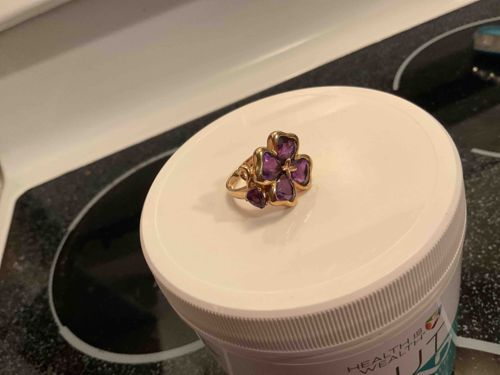
The item is a gold ring adorned with multiple amethyst gemstones. The central motif of the ring features a four-leaf clover design, with each leaf composed of a distinct purple amethyst stone. These four primary amethyst stones appear to be roughly heart-shaped or slightly rounded, forming a cohesive clover shape. There is a smaller, fifth amethyst stone positioned at the base of the clover, suggesting it might be part of the ring's shoulder or an additional accent. The gemstones are set in a yellow-gold metal, which, based on its color and luster, is likely 14k or 18k gold, though no specific hallmarks are visible in the provided image. The settings appear to be bezel or partial bezel, cradling each amethyst securely. The overall craftsmanship suggests a well-made piece, with no immediately apparent signs of damage such as cracks, chips, or missing stones. The gold itself shows a bright, polished finish, indicating good condition or recent cleaning. There are no discernible maker's marks, signatures, or specific manufacturing details visible from this view. The style appears somewhat vintage, possibly from the mid-to-late 20th century, given the design and use of cabochon-style or smoothly polished gemstones rather than faceted ones. The ring's size cannot be determined from the image, but it appears to be a substantial piece, likely a cocktail ring or a statement ring. The quality of the amethyst stones seems good, with a consistent, rich purple hue, and no significant inclusions are visible.
AI Appraisal Report
I have carefully examined the provided image of the Gold and Amethyst Four-Leaf Clover Ring. The ring appears to be in excellent condition, with a bright, polished yellow gold setting and vibrant purple amethyst stones. The craftsmanship seems solid, with stones securely set, likely in a bezel or partial bezel style, and no visible damage such as chips, cracks, or missing stones. Based on the aesthetic and stone cutting style, it has a vintage appeal, possibly from the mid-to-late 20th century.
Authenticity, when relying solely on images, presents limitations. While the gold color suggests 14k or 18k, a physical examination would be necessary to identify hallmarks for karatage and specific metal content. Similarly, the amethyst stones appear genuine, displaying good color and clarity for their type, but without direct inspection or gemological testing, I cannot definitively confirm they are natural or rule out synthetic alternatives or treatments. An in-person assessment would allow for verification of stone properties, setting integrity, and overall weight, which significantly impact value.
In terms of market conditions, vintage gold and gemstone jewelry, especially pieces with a distinct design like this four-leaf clover, generally maintain steady demand. Similar gold and amethyst rings typically retail based on gold weight, amethyst quality, and design uniqueness. Comparables for well-crafted vintage gold rings with natural amethyst in this style suggest values. Although not rare, the unique four-leaf clover motif adds to its desirability. Factors impacting value include the actual karat weight of the gold, the exact carat weight and origin of the amethysts, and any potential maker's marks, none of which are verifiable from the image alone. Without provenance documentation, full authentication of age and origin is also limited.