AI estimate as of December 9, 2025 · verify with a professional before acting
AI-Generated · Verify before acting
Everything on this page is generated by AI for informational purposes only. AI can make mistakes — the AI may misidentify items or misattribute them (artist, maker, brand, designer, origin, era). This is not an official valuation and should not be used for insurance, sale, tax, estate, legal, or lending purposes — or any decision requiring a certified appraisal. It is not an authoritative claim about any person, brand, or rights holder — do not share or rely on it as a factual statement about a third party. Always consult qualified professionals before making financial decisions.
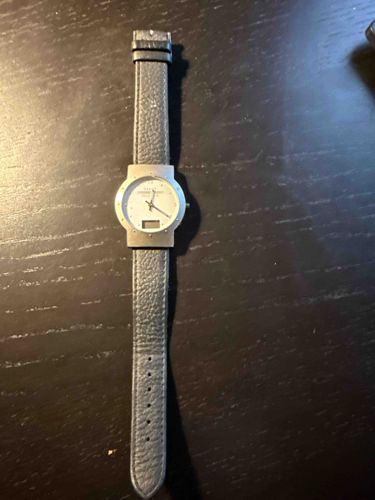
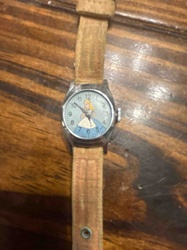
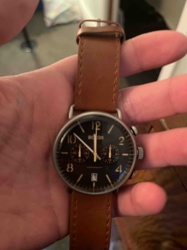
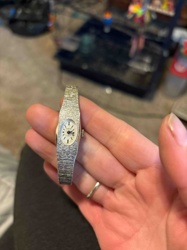
This is a vintage analog-digital quartz wristwatch, likely from the 1980s. The watch features a circular, off-white dial with black hour and minute hands, and a thin black second hand. Instead of traditional numerals or markers, the dial appears largely unadorned, contributing to a minimalist aesthetic. A prominent rectangular digital display is integrated into the bottom portion of the dial, showing either time or possibly other digital functions. The watch case is a subdued, matte metallic finish, possibly stainless steel or a type of base metal, with a design that creates a slightly recessed bezel around the crystal. There is a single crown visible on the right side of the case, suggesting a straightforward time-setting mechanism for the analog display, and possibly a pusher for the digital functions, though none are clearly visible besides the crown. The strap is made of black, textured leather, appearing aged with some wear and minor creasing, especially near the lugs and buckle end. The leather has a pebbled finish and features multiple adjustment holes, indicating adjustability for various wrist sizes. The buckle is a simple, possibly brushed metal tang buckle, consistent with the overall utilitarian design. The watch presents in used condition, showing signs of wear commensurate with its age, including potential scratches on the case and crystal, though these are not clearly discernible in the provided image. The overall style suggests a functional and somewhat classic design with the innovative inclusion of a digital display, characteristic of early analog-digital hybrid watches.
AI Appraisal Report
Based on my visual examination of the provided image, this vintage Seiko analog-digital quartz watch appears to be a genuine model from the 1980s, consistent with a period when such hybrid designs were innovative. The design elements, including the minimalist off-white dial, integrated rectangular digital display, matte metallic case, and textured black leather strap, align well with Seiko's offerings of that era.
The condition, from what I can discern, is good vintage condition. The strap shows expected wear, creasing, and some age, which is normal for an original leather strap of this age. The case appears to have a consistent finish. However, without a physical inspection, I cannot confirm the presence of scratches on the crystal or case, nor can I verify the functionality of both the analog and digital movements, which is crucial.
In terms of market conditions, vintage Seiko analog-digital watches have a dedicated collector base. While not as highly valued as some pure mechanical vintage pieces, these iconic '80s tech-watches are steadily gaining appreciation. Comparables in similar condition tend to fetch values in the $150-$250 range, with exceptional examples or rare models sometimes exceeding this. Demand is moderate, driven by nostalgia and collectors of vintage digital and hybrid timepieces. The rarity is moderate; they are not extremely common but do surface regularly. Key factors impacting value here are the actual working condition of both movements, the condition of the original crystal (any deep scratches or cracks), and whether the original strap and buckle are present, which appears to be the case here.
Limitations in authenticity verification are inherent with image-based appraisals. An in-person examination would be needed to verify the movement type, confirm all functions are working correctly, assess the integrity of the seals, thoroughly check for case and crystal damage, and potentially verify serial numbers against Seiko's records. Provenance documentation, such as original box or papers, would further solidify authenticity and could increase value.