AI estimate as of August 26, 2025 · verify with a professional before acting
AI-Generated · Verify before acting
Everything on this page is generated by AI for informational purposes only. AI can make mistakes — the AI may misidentify items or misattribute them (artist, maker, brand, designer, origin, era). This is not an official valuation and should not be used for insurance, sale, tax, estate, legal, or lending purposes — or any decision requiring a certified appraisal. It is not an authoritative claim about any person, brand, or rights holder — do not share or rely on it as a factual statement about a third party. Always consult qualified professionals before making financial decisions.
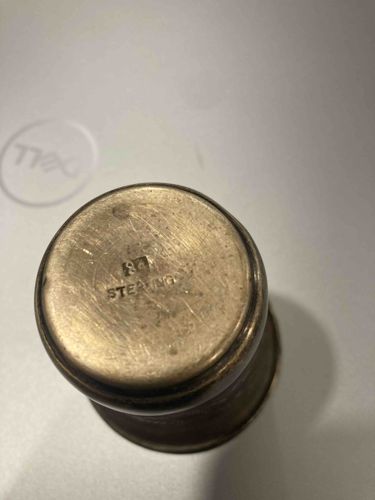
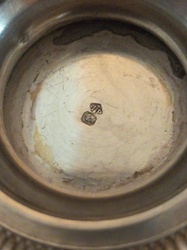
The item appears to be a small, circular metal object, likely part of a larger piece or a standalone miniature vessel, possibly an individual salt shaper, thimble, or measuring cup. Its top surface, which is largely visible, is circular and made of a tarnished yellowish-brown metal, consistent with aged sterling silver or a silver alloy that has developed a rich patina over time. The surface exhibits numerous fine scratches and scuff marks, indicative of substantial handling and use. The edge of the top surface shows some wear and rounding, with slight discoloration or darker oxidation in the crevices. Centrally located on the visible circular surface are engraved markings: "1874" appears prominently, followed by the word "STERLING" directly beneath it in uppercase letters. These markings confirm the material as sterling silver and suggest a significant age, with "1874" potentially indicating the year of manufacture or a specific design number associated with that year. While the full form of the item is not visible, its lower portion appears to narrow, hinting at a goblet, thimble, or measuring cup shape. The craftsmanship of the engraving seems precise, although the overall condition shows wear consistent with its apparent age, suggesting original good quality construction. The natural patina adds to its antique aesthetic.
AI Appraisal Report
Upon examining the provided image of this sterling silver object, my assessment suggests it is likely a small thimble or perhaps a miniature measuring cup, given its apparent size and shape. The "1874" engraving, followed by "STERLING," strongly indicates its material content and a significant age. The tarnished yellowish-brown patina is consistent with aged sterling silver that has not been recently polished, contributing to its antique aesthetic. The numerous fine scratches and scuff marks suggest considerable handling and use over its lifespan, which is expected for an item of this purported age. The precision of the engraving, even with wear, points to a good quality original manufacture.
Authenticity, based purely on visual examination, appears strong for the material given the "STERLING" mark. However, definitive authentication of the "1874" date mark as an original manufacturing date, rather than a later commemorative or decorative addition, would require in-person examination. Factors impacting value include its age, confirmed sterling silver content, and the unique historical engraving. Its smaller size and likely function as a thimble or miniature vessel might limit its appeal somewhat compared to larger tableware, yet the date adds historical significance.
The market for antique sterling silver, particularly items with clear date markings, remains stable but niche. Demand is driven by collectors of specific periods or silver types. This item's rarity lies more in its specific markings and potential historical context than in its form alone. Without physical inspection, I cannot verify the exact metal purity beyond the visual "STERLING" mark, nor can I definitively confirm the engraving's originality or rule out later alterations. A detailed in-person examination would involve a jeweler's loupe to inspect the engraving for tool marks consistent with the period, comparison with known hallmarks or manufacturer's marks from 1874 (if any are present but obscured), and potentially specific gravity testing for metal composition if significant doubt arose. Provenance documentation, if available, would significantly enhance authentication and value. Without these, my appraisal carries the inherent limitation of image-based assessment.