These notes were written by the person who submitted this item. Appraiser.AI has not verified them, and the AI's identification and estimate may rely on them.
AI Estimated Value
Not an official valuation
$500 - $1,500
AI estimate as of July 23, 2025 · verify with a professional before acting
AI-Generated · Verify before acting
Everything on this page is generated by AI for informational purposes only. AI can make mistakes — the AI may misidentify items or misattribute them (artist, maker, brand, designer, origin, era). This is not an official valuation and should not be used for insurance, sale, tax, estate, legal, or lending purposes — or any decision requiring a certified appraisal. It is not an authoritative claim about any person, brand, or rights holder — do not share or rely on it as a factual statement about a third party. Always consult qualified professionals before making financial decisions.
This analysis also relies on unverified notes provided by the user, which may be incomplete or inaccurate and could affect the result.
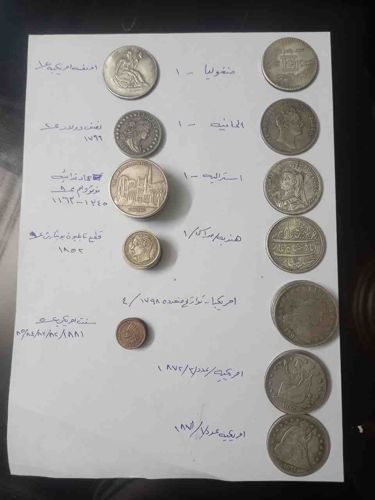
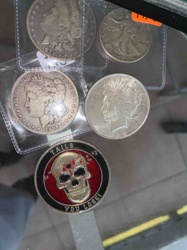
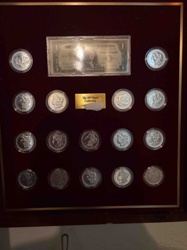
The item is a collection of 12 assorted historical coinage displayed on a white sheet of paper with handwritten Arabic annotations next to each coin, indicating their origin, denomination, and sometimes date. The coins vary significantly in size, metallic composition, and design, suggesting a diverse numismatic assemblage rather than a single set. Some coins appear to be silver, exhibiting a characteristic tarnished patina and retaining some luster, while others are copper or bronze, showing darker oxidation and less reflectivity. Physical characteristics include a range of diameters, from small buttons to larger, more substantial discs.
Observable details of specific coins include:
- A large silver coin with the image of a seated Liberty, likely a U.S. Seated Liberty Quarter or Half Dollar, with visible wear on the high points of the design. The Arabic text next to it mentions 'America - specified dates 1798/4' and 'American Dollar 187'.
- Another silver coin features a draped bust, possibly an early U.S. Draped Bust dollar or half dollar, also showing significant wear consistent with circulation.
- Multiple coins display intricate portraits of monarchs or figures, suggesting European or Asian origins. For example, one large silver coin on the right column has an ornate, possibly Middle Eastern, script on its obverse.
- A small copper coin appears to be a U.S. large cent or similar denomination, with the Arabic text 'American Cent 1881, 1884, 1888'.
- One coin shows an architectural rendering, possibly a cathedral or other significant building, which might be a commemorative or a specific country's architectural series.
- The overall condition of the coins ranges from heavily circulated with significant wear to moderately circulated with visible details. Patina is present on most coins, indicating their age and interaction with the environment. No obvious signs of cleaning, polish, or severe damage like dents or scratches are widely apparent across the collection, though specific coins might have minor rim nicks or surface abrasions. The quality of striking varies, as is common with historical coinage, with some displaying sharp details and others appearing softer. The craftsmanship of the dies is evident in the intricate designs, even with wear.
The Arabic script beside each coin seems to provide identification, suggesting a curated collection, possibly for educational or appraisal purposes.
AI Appraisal Report
I have carefully examined the image of this Assorted Historical Coin Collection with Annotations. From my visual assessment, the collection presents a diverse numismatic assemblage, ranging from what appear to be U.S. Seated Liberty and Draped Bust coinage to various European and potentially Middle Eastern issues. The coins exhibit a range of metallic compositions including silver, copper, and bronze, and their conditions vary from heavily circulated to moderately circulated, consistent with historical coinage that has seen significant use. The presence of natural patina on most coins suggests they have not been harshly cleaned, which is a positive factor for their preservation and value.
Authenticity: Based solely on the visual examination of the image, the coins appear to be genuine historical artifacts. The visible wear patterns, patinas, and design intricacies are consistent with circulated coinage of the periods suggested by the annotations. However, definitive authentication cannot be performed without a physical inspection. An in-person examination would allow for tactile assessment, detailed evaluation of strike quality, die varieties, and edge conditions, which are critical for authentication and grading. Furthermore, forensic numismatic tools such as magnification, specific gravity testing, or X-ray fluorescence (XRF) would be necessary to confirm metallic composition and rule out counterfeits or replicas. Provenance documentation, if available, would also significantly aid in confirming authenticity and historical lineage, especially for higher value pieces.
Market Conditions and Comparables: The market for historical coinage is robust, driven by collectors, historians, and investors. Coins like the U.S. Seated Liberty and Draped Bust types are perennial collector favorites. The value of individual coins within this collection would largely depend on their specific type, actual date, mint mark, precise condition (grade), and rarity. Given the descriptive annotations, a 1798 American Dollar or Draped Bust coinage could represent significant value, even in circulated condition, due to their scarcity. Similarly, certain foreign coins, especially those with intricate designs or historical significance, can command strong prices.
Demand and Rarity: There is consistent demand for authentic historical coinage, particularly for key dates or rare varieties. The mention of specific dates like 1798 or 187[x] for American pieces suggests potential rarity. The foreign coins, while less specifically identified, could also include rare or historically significant pieces, particularly if they are from lesser-known issuers or periods of high demand for certain regions. The lack of detailed identification of all coins, however, limits a precise assessment of rarity for the entire collection.
Factors Impacting Value: The primary factors impacting value are authenticity, condition (grade), rarity (mintage figures, surviving examples), and market demand for specific types. As mentioned, exact grading is impossible from an image, and even moderate circulation can significantly reduce value compared to uncirculated examples, though very rare coins still hold considerable value even in low grades. A professional grading service (e.g., PCGS, NGC) would provide consistent and respected grades, enhancing marketability and confirming authenticity for higher-value pieces. The collection’s overall appeal as a diverse group is also a contributing factor, as it offers a broad historical scope.
Limitations: Without physical access to the coins, I cannot verify their exact weight, diameter, edge characteristics, or true surface integrity. These details are vital for accurate grading and absolute authentication. The Arabic annotations are helpful but require verification against established numismatic references. Therefore, the appraisal provided is based on the strong likelihood of authenticity as suggested by the visual evidence, but it remains provisional without physical inspection and comprehensive research.