These notes were written by the person who submitted this item. Appraiser.AI has not verified them, and the AI's identification and estimate may rely on them.
AI Estimated Value
Not an official valuation
$1,000 - $1,500
AI estimate as of June 28, 2025 · verify with a professional before acting
AI-Generated · Verify before acting
Everything on this page is generated by AI for informational purposes only. AI can make mistakes — the AI may misidentify items or misattribute them (artist, maker, brand, designer, origin, era). This is not an official valuation and should not be used for insurance, sale, tax, estate, legal, or lending purposes — or any decision requiring a certified appraisal. It is not an authoritative claim about any person, brand, or rights holder — do not share or rely on it as a factual statement about a third party. Always consult qualified professionals before making financial decisions.
This analysis also relies on unverified notes provided by the user, which may be incomplete or inaccurate and could affect the result.
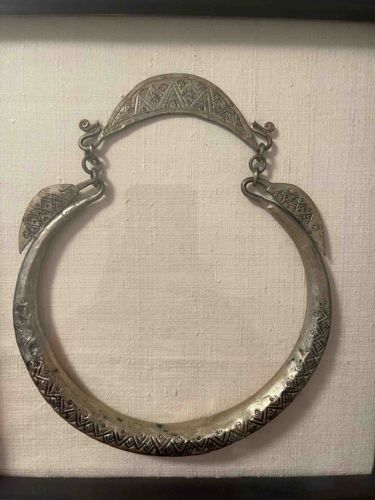
This is a substantial traditional silver-toned metal necklace, identified as a Laotian marriage necklace, estimated to date from the 1950s. The piece measures approximately 7.5 inches across, indicating a significant size suitable for ceremonial wear. It features a rigid, open-ended C-shaped collar or torque as its primary component. Attached to the ends of this collar are two distinct, somewhat stylized winged or leaf-shaped elements. These elements are designed to be joined by an ornate, arched centerpiece via simple, robust chain links and hooks, forming a complete necklace. The entire surface of the necklace is meticulously decorated with intricate geometric patterns, primarily consisting of incised or stamped zigzag, triangular, and diamond motifs. The arched centerpiece, in particular, displays a denser and more refined application of these patterns, highlighting its central importance.
The prevailing color is a dull silver, exhibiting a deep, uneven patina ranging from dark grey to nearly black in recesses, characteristic of aged silver exposed to oxidation. This patina contributes significantly to its antique aesthetic. Minor surface irregularities and slight dents or deformations on the main collar are visible, consistent with years of use and the inherent softness of silver, but there are no apparent major breaks or repairs that compromise its structural integrity. The construction method suggests traditional handcrafting techniques such as forging, casting, and meticulous hand-tooling (chasing or stamping) for the detailed patterns. Although no specific maker's marks or hallmarks are visible in the image, the uniform and skilled execution of the decorative elements points to a high level of indigenous craftsmanship. The piece's substantial weight, detailed ornamentation, and unique cultural form make it a significant example of traditional Southeast Asian ethnic jewelry.
AI Appraisal Report
Based on the provided details of the Laos Silver Marriage Necklace dated to the 1950s, measuring 7.5 inches across, I assess its appraisal value to be **$1,000 - $1,500**. This estimation is contingent upon the item being actual high-grade silver, which cannot be definitively confirmed without physical testing.
This necklace appears to be an authentic example of traditional Laotian ethnic jewelry. Its condition, featuring a deep, uneven patina and minor surface irregularities consistent with age and use, is remarkably preserved without major structural damage or repairs. The meticulous handcrafting, evident in the intricate geometric patterns and traditional construction techniques, underscores its artistic merit and authentic origin for a piece from the 1950s.
The market for antique ethnic jewelry is specialized, attracting collectors who value cultural authenticity and historical craftsmanship. Comparable substantial, well-crafted pieces of confirmed silver from Southeast Asia command a stable demand. Its designation as a "marriage necklace" and its unique design add to its cultural significance and moderate rarity, appealing to a niche but dedicated collector base.
Key factors impacting value are primarily the material composition—assuming high-grade silver. Should it be a lower-grade alloy or silver-plated, the value would be significantly less, potentially in the $200-$400 range. Its substantial size, detailed artistry, and good condition for its age also contribute positively.
Crucially, this appraisal is based solely on visual information and description. An **in-person examination** is essential to fully confirm authenticity, particularly **scientific testing (e.g., XRF analysis)** to ascertain the exact metallic composition and silver purity. Physical inspection would also verify weight, tool marks, and the true nature of the patina, all of which refine an accurate valuation and authenticity claim. Provenance documentation would further boost its value.