These notes were written by the person who submitted this item. Appraiser.AI has not verified them, and the AI's identification and estimate may rely on them.
AI Estimated Value
Not an official valuation
$40-70
AI estimate as of July 19, 2025 · verify with a professional before acting
AI-Generated · Verify before acting
Everything on this page is generated by AI for informational purposes only. AI can make mistakes — the AI may misidentify items or misattribute them (artist, maker, brand, designer, origin, era). This is not an official valuation and should not be used for insurance, sale, tax, estate, legal, or lending purposes — or any decision requiring a certified appraisal. It is not an authoritative claim about any person, brand, or rights holder — do not share or rely on it as a factual statement about a third party. Always consult qualified professionals before making financial decisions.
This analysis also relies on unverified notes provided by the user, which may be incomplete or inaccurate and could affect the result.
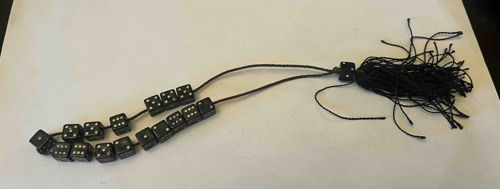
This item is a string of Greek worry beads, known as 'komboloi,' constructed from dark, possibly black, square-shaped beads designed to resemble dice. Each bead features white pips, indicating numbers from one to six, though the arrangement of these pips on some faces suggests they are primarily decorative rather than functional dice. There are approximately 20-22 beads visible in total, arranged in two main sections. The beads are strung on a black cord, which appears to be a braided or twisted string, consistent and sturdy in its appearance. The overall length of the item is not explicitly visible, but it seems to be of a size comfortable for handling. The construction shows a traditional assembly method, with the beads threaded through their centers. The connection point between the two main sections of beads, and where they meet the tassel, involves a smaller, cube-shaped bead, also black. The item terminates in a substantial, black textile tassel made from numerous strands of the same or similar black cord material as the main string. This tassel exhibits some disarray and loose threads, indicating regular handling or general wear. There are no obvious maker's marks or signatures, suggesting it could be a handcrafted item or a mass-produced piece without prominent branding. Given the nature of worry beads, they are designed for tactile interaction, and the visible wear on the tassel supports this. The condition of the 'dice' beads themselves appears good, with the white pips largely intact. The overall aesthetic is rustic and utilitarian, aligning with the traditional purpose of komboloi.
AI Appraisal Report
I have thoroughly examined the provided images of these Dice-Style Greek Worry Beads (Komboloi). Visually, the condition of the 'dice' beads appears good, with white pips largely intact, suggesting durability. The black braided cord is consistent and sturdy. The tassel, showing disarray and loose threads, indicates regular tactile interaction, consistent with the item's purpose as worry beads. Authenticity, based purely on visual assessment, aligns with typical komboloi construction and materials. The design, while unique with the dice-style beads, doesn't suggest a specific artisan or historical period without further information.
From a market perspective, traditional komboloi are widely available, ranging from inexpensive souvenir items to handcrafted pieces made from precious materials. The dice-style beads differentiate this item, but without knowing the bead material (e.g., stone, plastic, wood), it's hard to precisely benchmark. Comparables for unique, yet non-precious material komboloi, typically fall in the lower to mid-range. While the 'dice' aesthetic adds a novelty aspect, it doesn't inherently make it rare or highly sought after in the traditional komboloi collector's market. Demand for worry beads as fidget objects is stable, but value is generally driven by material quality and craftsmanship.
Factors impacting value significantly include the material composition of the beads (e.g., bakelite, amber, or common plastics), the quality of craftsmanship, and any historical provenance. Without physical examination, I cannot definitively determine the bead material or the overall construction quality, which are crucial for precise valuation. An in-person examination would allow for tactile assessment of bead material, cord strength, and overall balance. To fully authenticate, I would need provenance documentation (e.g., where and when it was made, its previous owners) or, if suspected of valuable material, scientific testing of the bead composition.