These notes were written by the person who submitted this item. Appraiser.AI has not verified them, and the AI's identification and estimate may rely on them.
AI Estimated Value
Not an official valuation
$15 - $40
AI estimate as of June 30, 2025 · verify with a professional before acting
AI-Generated · Verify before acting
Everything on this page is generated by AI for informational purposes only. AI can make mistakes — the AI may misidentify items or misattribute them (artist, maker, brand, designer, origin, era). This is not an official valuation and should not be used for insurance, sale, tax, estate, legal, or lending purposes — or any decision requiring a certified appraisal. It is not an authoritative claim about any person, brand, or rights holder — do not share or rely on it as a factual statement about a third party. Always consult qualified professionals before making financial decisions.
This analysis also relies on unverified notes provided by the user, which may be incomplete or inaccurate and could affect the result.
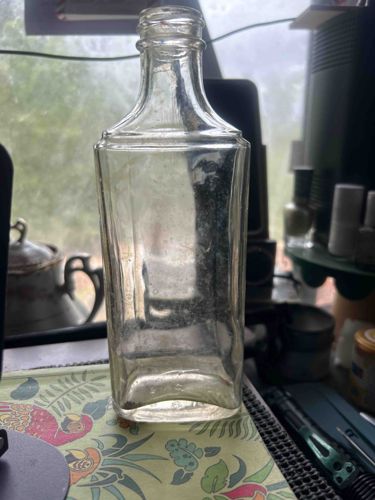
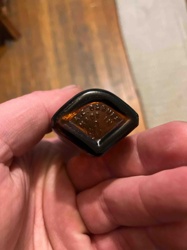
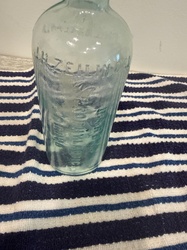
This item is an antique or vintage clear glass bottle, characterized by its distinctive square cross-section body and relatively short, tapering neck. The bottle is constructed from colorless, translucent glass, exhibiting a utilitarian design commonly associated with flask bottles, possibly used for spirits, pharmaceuticals, or household liquids. The main body features four flat panels, forming a square silhouette, with corners that are gently rounded rather than sharply angled. The shoulders of the bottle smoothly curve inward from the square body to transition into a circular neck, which then terminates in a simple, unembellished lip. While precise measurements are unavailable, it appears to be a medium-sized bottle, likely ranging from 6 to 8 inches in height. Visible condition issues include significant interior cloudiness and residue, commonly referred to as "sick glass" or "bottle sickness," which is indicative of prolonged exposure to liquids, minerals, or environmental factors. This cloudiness is a form of patina that has developed over time. The exterior surface shows general scuffing and light scratches consistent with handling and age, but no apparent major cracks, chips, or fractures are discernible. The base of the bottle exhibits a slightly concave punt, a common feature in blown or molded glass bottles, but no clear embossed text, maker's marks, or mold numbers are distinctly visible in the provided images. The lip appears to be a continuous thread finish designed for a screw-top closure, rather than a cork or crown cap, suggesting a manufacturing period likely from the late 19th century into the first half of the 20th century, consistent with mass production techniques. The "D 1230" provided in the context implies a specific design patent or catalog number, indicating it was a standardized product. Its craftsmanship is functional and robust rather than decorative, typical of bottles produced for widespread commercial use.
AI Appraisal Report
Upon my examination of the provided image of this clear square flask bottle, identified as a 'D 1230 Type,' I observe a utilitarian glass vessel exhibiting characteristics consistent with late 19th to early 20th-century production. The most significant condition issue is the extensive interior cloudiness, commonly known as 'sick glass' or 'bottle sickness.' This irreversible patination significantly diminishes the aesthetic appeal and, consequently, the market value. Exterior scuffing and light scratches are also present, typical of age and use. Authenticity as an antique or vintage utilitarian bottle appears evident from its form and manufacturing style; however, the specific 'D 1230' designation cannot be verified without physical inspection of patents or catalogs.
In the current market, common utilitarian glass bottles, particularly those with significant condition issues like severe cloudiness and lacking distinct maker's marks or historical ties, tend to command relatively low prices. Comparables frequently sell in the $10-$40 range, depending on size, color, and lack of damage. Demand for such items is generally limited to casual collectors or those seeking decorative fillers, not high-end collectors. The primary factor impacting value negatively is the severe 'sick glass.' The absence of identifiable embossing or a unique color also limits appeal. While the 'D 1230 Type' suggests a specific design, without further documentation or unique features, it doesn't significantly enhance rarity or value.
To provide a definitive appraisal and authenticate the 'D 1230' designation, a physical inspection would be crucial. This would allow for a precise examination of the lip finish (to confirm screw-top), any faint base markings, glass quality, and to potentially match it with historical catalogs or patent records. Provenance, if available, would also be invaluable. Without these, my assessment remains based solely on visual evidence and general market trends.