AI estimate as of July 10, 2025 · verify with a professional before acting
AI-Generated · Verify before acting
Everything on this page is generated by AI for informational purposes only. AI can make mistakes — the AI may misidentify items or misattribute them (artist, maker, brand, designer, origin, era). This is not an official valuation and should not be used for insurance, sale, tax, estate, legal, or lending purposes — or any decision requiring a certified appraisal. It is not an authoritative claim about any person, brand, or rights holder — do not share or rely on it as a factual statement about a third party. Always consult qualified professionals before making financial decisions.
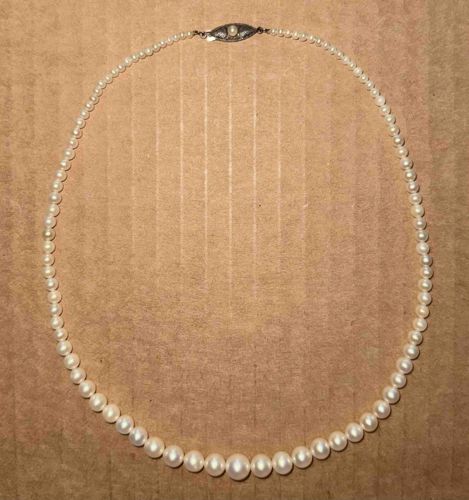
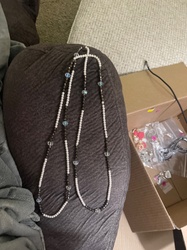
This item is a graduated pearl necklace, featuring a single strand of pearls that increase in size towards the center. The pearls exhibit a classic white to off-white coloration with a visible luster, indicating their quality. The smallest pearls, near the clasp, appear to be approximately 2-3mm in diameter, gradually increasing to the largest pearls at the front, which seem to be around 6-8mm. While the exact material of the pearls (natural, cultured, or imitation) cannot be definitively determined from the image alone, their uniformity in shape and sheen suggests they are either well-matched cultured pearls or high-quality imitation pearls. Each pearl is individually strung, and there are no visible knots between them, which is a common practice in stringing older pearl necklaces. The necklace features an ornate, possibly Art Deco or early 20th-century style clasp. The clasp appears to be made of a silver-toned metal, possibly sterling silver or white gold, and is marquise or navette-shaped, set with what looks like small, faceted stones (possibly marcasites or tiny diamonds) surrounding a central small pearl or gem. The metal of the clasp shows some signs of patina or oxidation, consistent with age. There are no obvious signs of severe damage such as broken pearls, significant scratching, or major repairs. The overall condition appears to be good vintage, with the potential for minor wear consistent with its age and use. The craftsmanship of the stringing appears consistent, and the clasp, while showing age, seems to be intact and functional.
AI Appraisal Report
Upon visual examination of this graduated pearl necklace, I observe a classic design with pearls ranging from approximately 2-3mm near the clasp to 6-8mm at the center. The pearls exhibit good luster and uniformity in shape, suggesting they are either high-quality cultured pearls or very well-made imitation pearls. Without in-person inspection, I cannot definitively determine their material composition (natural, cultured, or imitation), which is a significant factor in valuation. The stringing appears consistent, with no visible knots between individual pearls, a common characteristic of older pieces. The ornate, possibly Art Deco-era, clasp is a key feature. It appears to be a silver-toned metal, likely sterling silver or white gold, set with small, faceted stones (possibly marcasites or tiny diamonds) surrounding a central pearl or gem. The clasp shows an age-appropriate patina and appears intact. The overall condition is good vintage, showing expected wear consistent with its age.
Market conditions for vintage pearl necklaces vary significantly based on pearl type. Assuming these are cultured pearls, similar pieces with decorative clasps might fetch higher values. If they are natural pearls, the value would be substantially greater; conversely, if they are imitation, the value would be considerably lower. The ornate clasp adds sentimental and aesthetic value, particularly if the small stones are genuine diamonds.
Factors significantly impacting value are the true nature of the pearls and the clasp's materials. To fully authenticate, an in-person examination would be required to assess the pearls' nacre thickness, uniformity, and potential for natural origin through x-ray or gemological testing. The clasp's metal purity and the identity of the small stones would also need to be confirmed via testing. Provenance documentation, if available, could also enhance authenticity and value.