AI estimate as of August 15, 2025 · verify with a professional before acting
AI-Generated · Verify before acting
Everything on this page is generated by AI for informational purposes only. AI can make mistakes — the AI may misidentify items or misattribute them (artist, maker, brand, designer, origin, era). This is not an official valuation and should not be used for insurance, sale, tax, estate, legal, or lending purposes — or any decision requiring a certified appraisal. It is not an authoritative claim about any person, brand, or rights holder — do not share or rely on it as a factual statement about a third party. Always consult qualified professionals before making financial decisions.
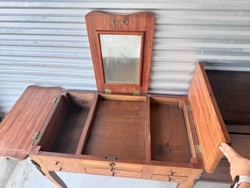
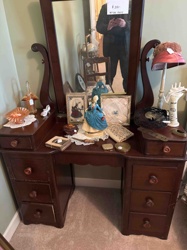
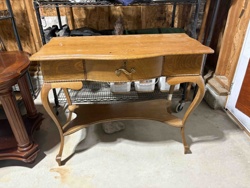
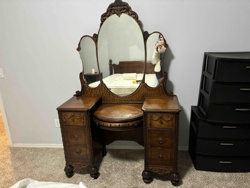
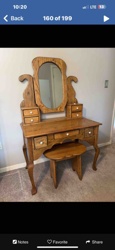
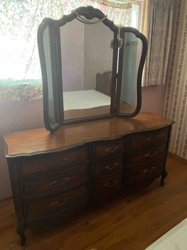
This appears to be a vintage wooden vanity or dressing table, likely dating from the mid-20th century, possibly in the French Provincial or Rococo Revival style due to its ornate carvings and curved lines. The main body of the furniture is a rich, reddish-brown wood, potentially mahogany or walnut, exhibiting a visible wood grain. The finish shows signs of wear, including scuffs, scratches, and some loss of luster, particularly on the top surface and edges of the drawers, indicating age and use. The vanity features a prominent, large, arched mirror with an elaborately carved wooden frame at the top, showcasing scrollwork and floral motifs. The mirror itself appears to be in fair condition, reflecting the room without significant distortion or clouding, though minor silvering degradation cannot be ruled out from this angle. The vanity consists of a central kneehole space, flanked by two pedestals. The left pedestal has two drawers with curved fronts, adding to the ornate aesthetic. The drawer pulls appear to be brass or an aged metal, with a decorative design complementing the overall style. The right pedestal's configuration is less clear but likely mirrors the left or contains a similar storage solution. The legs of the vanity also exhibit carved details, possibly cabriole-style with decorative feet. There are no immediate visible maker's marks or signatures, but the craftsmanship, particularly the detailed carvings, suggests a mass-produced, yet well-styled, furniture piece from its era. The overall condition suggests that while functional, it would benefit from restoration to fully bring back its original beauty.
AI Appraisal Report
This vintage carved wood dressing table with mirror appears to be a mid-20th-century piece, likely in the French Provincial or Rococo Revival style, given its ornate carvings, curved lines, and overall aesthetic. The wood, possibly mahogany or walnut, shows a reddish-brown hue and visible grain. The condition is fair to good, consistent with its age and use. I observe scuffs, scratches, and some finish loss on the top surface and drawer edges, suggesting it has been well-used but cared for. The prominent arched mirror seems to be in good condition, reflecting clearly, though only an in-person inspection could confirm the absence of subtle silvering degradation. The brass or aged metal drawer pulls complement the design well. While the craftsmanship is apparent, particularly in the detailed carvings, the lack of immediate maker's marks, as noted, suggests mass-produced furniture of its era rather than a unique artisan piece.
In terms of market conditions, there's a steady but not exceptionally high demand for vintage furniture of this style. Pieces requiring restoration, like this one, typically fetch lower prices. Comparables in similar condition often sell in the mid-hundreds. The ornate carving adds to its appeal, but the wear and tear reduce its immediate 'display-ready' value. The primary factors impacting value are the need for refinishing to restore its original luster and the absence of a known maker, which would elevate its rarity and demand. Without direct physical examination, I cannot definitively verify the wood type or the exact extent of wear that might require more extensive repair. Provenance documentation could also significantly impact its value, especially if a renowned previous owner or a specific history could be established. Scientific testing would be needed to precisely identify the wood species and age, if such details were critical for a specific buyer.