AI Appraisal Estimate

AI-generated estimates · not official valuations

From the user

What was submitted

Photo and notes provided by the user — not generated by AI

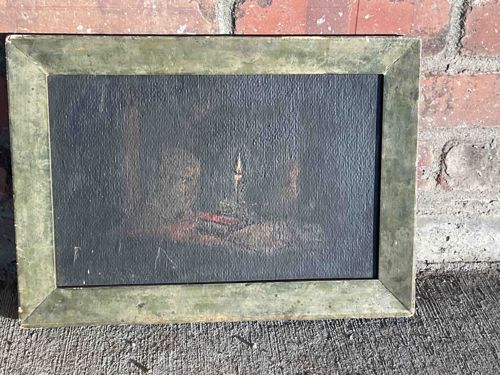
Submitted item photo
Submitted photo · July 3, 2026

User's notes

No additional notes provided.

AI analysis below

AI appraisal

AI analysis & estimate

AI-Generated · Verify before acting

Everything below is generated by AI for informational purposes only. AI can make mistakes — the AI may misidentify items or misattribute them (artist, maker, brand, designer, origin, era). This is not an official valuation and should not be used for insurance, sale, tax, estate, legal, or lending purposes — or any decision requiring a certified appraisal. It is not an authoritative claim about any person, brand, or rights holder — do not share or rely on it as a factual statement about a third party. Always consult qualified professionals before making financial decisions.

Read the full disclaimer

AI Identification

·Not independently authenticated·Verify before acting

Antique Tenebrist Still Life Oil Painting with Candle

Fine Art - Paintings

AI Estimated Value

·Not an official valuation·Verify before acting

$450.00 - $750.00

As of July 3, 2026

AI Item Analysis

·AI can make mistakes·Verify before acting
This is an antique oil painting executed in a somber, Tenebrist style, likely dating from the late 19th to early 20th century. The composition features a low-light still life arrangement centered around a single glowing candle, which illuminates nearby objects including what appears to be a skull (Memento Mori motif) and various books or scrolls. The artwork is characterized by a heavy 'impasto' texture and a prominent canvas grain, which suggests it was painted on a coarse linen or a prepared artist board. The color palette is extremely restricted, dominated by deep ochres, burnt umbers, and lamp blacks, with the only bright focal point being the yellow-white of the candle flame. The piece is housed in a wide, flat-profile timber frame that has been painted or gilded in a muted greenish-gold tone, now showing significant distress. Regarding condition, the painting exhibits heavy surface grime and a yellowed varnish that has likely darkened the original pigments. There is visible edge wear along the frame, including abrasions and small chips to the finish, along with some minor paint loss spots on the lower-left section of the canvas. The overall presentation suggests a piece that was intentionally crafted to mimic the Old Master style of the 17th century, emphasizing dramatic light and shadow (chiaroscuro). No signature is immediately visible in the lower registers, which is common for academic studies or works from this period favoring a moody, atmospheric aesthetic.


AI Appraisal Report

·AI can make mistakes·Verify before acting
Based on my visual examination of this Tenebrist still life, I assess the work as an early 20th-century academic exercise or 'Old Master' pastiche. The painting utilizes a classic Memento Mori motif, featuring a skull and candlelight. While the heavy impasto and dramatic chiaroscuro successfully evoke the 17th-century aesthetic, the visible canvas grain and specific pigment aging suggest a later execution. The condition is fair to good; however, significant surface grime, a yellowed varnish layer, and minor paint loss in the lower-left quadrant necessitate professional conservation to restore clarity. The distressed timber frame is period-appropriate but shows notable edge wear. The lack of a visible signature typically reduces the ceiling for market value, as the piece must be sold as 'Attributed' or 'School of.' Market demand for moody, atmospheric still lifes remains steady among interior designers and collectors of Gothic or Macabre art, though the current 'dark' condition may deter some buyers. Comparables for unsigned late 19th-century studies of this size and subject matter consistently fall within the $400-$800 range at regional auctions. Limitations: This appraisal is based strictly on photographic evidence. I cannot definitively verify the age of the pigments or the presence of a hidden signature beneath the grime without a physical inspection. A full authentication would require UV fluorescence testing to identify overpainting, a cleaning test to assess the stability of the paint layer, and an examination of the stretcher bars and staples/nails to confirm the construction date of the support.

Get your items appraised

Instant estimates of your treasures with AI-powered appraisals

Browse More Appraisals