AI estimate as of July 17, 2025 · verify with a professional before acting
AI-Generated · Verify before acting
Everything on this page is generated by AI for informational purposes only. AI can make mistakes — the AI may misidentify items or misattribute them (artist, maker, brand, designer, origin, era). This is not an official valuation and should not be used for insurance, sale, tax, estate, legal, or lending purposes — or any decision requiring a certified appraisal. It is not an authoritative claim about any person, brand, or rights holder — do not share or rely on it as a factual statement about a third party. Always consult qualified professionals before making financial decisions.
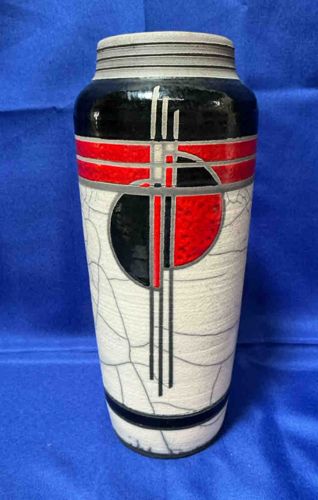
This is an elongated, cylindrical art pottery vase, likely ceramic or earthenware, exhibiting a distinctive Art Deco or Bauhaus design aesthetic. The vase is primarily off-white or light grey, with a striking crackle glaze evident across much of its surface, indicating an intentional finish rather than damage. The top portion of the vase transitions to a glossy black glaze, adorned with horizontal red and silver or grey bands that encircle the circumference. A prominent geometric design, abstract in nature, is centered on the body of the vase. This design features interlocking elements of black and red semicircles or quarter-circles, intersected by thin, vertical and horizontal lines in black and silver/grey, creating a dynamic, architectural motif. The rim of the vase is banded with horizontal grooves, finished in a light grey or silvery tone, and the base also has a black band. The glossy black areas contrast sharply with the matte or semi-matte finish of the crackle glaze. There are no visible chips or significant breaks, but the crackle pattern, a deliberate artistic effect, covers the majority of the light-colored body. This design strongly suggests a manufacturing period from the 1920s to 1940s, typical of the geometric and industrial influences of the Art Deco movement. The craftsmanship appears to be of good quality, with clean lines and vibrant glazes, indicative of a mass-produced, yet stylistically significant, decorative object.
AI Appraisal Report
Upon examining the images provided, this vase presents as a quintessential example of Art Deco geometric design, likely originating from the 1920s-1940s. The combination of a crackle glaze body with glossy black, red, and silver geometric motifs is characteristic of the period, suggesting influences from movements like Bauhaus or De Stijl. The form is strong, and the execution of the glaze and linear patterns appears to be of good quality for a mass-produced decorative item of its time. The crackle glaze is clearly an intentional artistic effect, not post-production damage, and the overall condition appears excellent for its age, with no visible chips or cracks.
The market for authentic Art Deco ceramics remains steady, with particular interest in pieces exhibiting bold, architectural designs like this one. Similar, unsigned geometric vases from this era typically trade in the low to mid-hundreds, depending on the maker, complexity, and condition. The primary factor limiting the value is its likely mass-produced, unsigned nature. If a maker's mark (e.g., from a known French, German, or Belgian pottery) were discovered, the value could increase significantly.
However, a definitive authentication from images alone is impossible. A physical examination is required to assess the weight, texture, and feel of the piece, and to search for any impressed or painted maker's marks on the underside, which are not visible in the photos. Confirming the age and origin would solidify its place in the market and thus its value.