AI estimate as of September 2, 2025 · verify with a professional before acting
AI-Generated · Verify before acting
Everything on this page is generated by AI for informational purposes only. AI can make mistakes — the AI may misidentify items or misattribute them (artist, maker, brand, designer, origin, era). This is not an official valuation and should not be used for insurance, sale, tax, estate, legal, or lending purposes — or any decision requiring a certified appraisal. It is not an authoritative claim about any person, brand, or rights holder — do not share or rely on it as a factual statement about a third party. Always consult qualified professionals before making financial decisions.
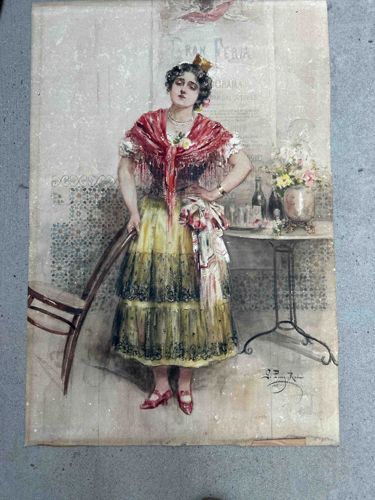
This is a vintage chromolithograph or art print, likely mounted on board, depicting a woman in traditional Spanish or flamenco attire. The print features a central figure, a woman with dark, curly hair adorned with a small crown or tiara and a pink flower, and a pearl necklace. She wears a vibrant red fringed shawl over a white blouse, and a multi-tiered skirt in shades of yellow and olive green, with black lace accents. Her posture suggests a moment of contemplation or weariness, with one hand on her hip and the other resting on the back of a wooden chair. To her right, a small round table with an ornate metal base holds a decorative vase overflowing with light-colored flowers (pinks, yellows, whites, greens), two dark bottles (possibly wine), and several glasses. The background suggests an outdoor or semi-outdoor setting, with a tiled wall to the left (featuring blue and white patterns) and a light-colored wall or banner behind the woman. The banner has faded writing, which appears to say "GRAN FERIA" (Great Fair), indicating the print might be an advertisement or commemorative piece for a fair or festival. Above the woman's head, a stylized red bird or creature is visible. The print exhibits signs of age and wear, including discoloration, smudges, and minor abrasions consistent with its age. The edges appear worn, and there's some visible damage or creasing, particularly at the bottom right corner, suggesting it was once pasted or adhered to a surface. There is a discernible signature or mark in faded black ink on the lower right, possibly 'R. Riu' or a similar script, although it is difficult to read precisely. The style points to a late 19th to early 20th-century period, characterized by romanticized realism and vibrant coloring typical of chromolithography from that era. The quality of the printing is evident in the detail and color gradation.
AI Appraisal Report
Based on my visual examination of the provided image, this "Gran Feria" Spanish Lady Chromolithograph appears to be a genuine vintage chromolithograph, likely dating from the late 19th to early 20th century. The characteristic vibrant coloring, detail, and commercial advertising style are consistent with chromolithography from that era. The faded "GRAN FERIA" text suggests it was an advertisement or commemorative piece, adding to its historical context.
The condition, however, is a significant factor impacting its value. I observe considerable signs of age and wear, including discoloration, smudges, abrasions, and noticeable creasing/damage, particularly the bottom right corner, indicating it may have been mounted and later removed. The discernible signature 'R. Riu' is intriguing but difficult to verify definitively from the image alone. These condition issues detract from its marketability.
Market conditions for vintage chromolithographs, especially those not by highly famous artists or with exceptional rarity, are generally moderate. While there's a steady interest in decorative art from this period, prints in fair to poor condition often command lower prices. Comparables for similar decorative chromolithographs of the period, particularly those used for advertising, would typically fall into this range, especially given the condition.
Demand for this specific type of print is niche, appealing mainly to collectors of vintage advertising, Spanish cultural ephemera, or decorative art. Its rarity is not exceptionally high, as chromolithographs were mass-produced. The wear and tear reduce its aesthetic appeal for general decorative purposes.
It is crucial to note the limitations of authenticating solely from images. A full authentication would require in-person examination to assess paper quality, printing technique, and true color fidelity, which can be obscured by photography. Provenance documentation, if available, would provide invaluable context and confirm its history. Scientific testing, such as pigment analysis, could confirm the age of the materials. Without physical inspection, the precise dating and full extent of damage are estimates. The signature also needs close in-person verification to ascertain its legitimacy and identify the artist positively.