AI estimate as of August 8, 2025 · verify with a professional before acting
AI-Generated · Verify before acting
Everything on this page is generated by AI for informational purposes only. AI can make mistakes — the AI may misidentify items or misattribute them (artist, maker, brand, designer, origin, era). This is not an official valuation and should not be used for insurance, sale, tax, estate, legal, or lending purposes — or any decision requiring a certified appraisal. It is not an authoritative claim about any person, brand, or rights holder — do not share or rely on it as a factual statement about a third party. Always consult qualified professionals before making financial decisions.
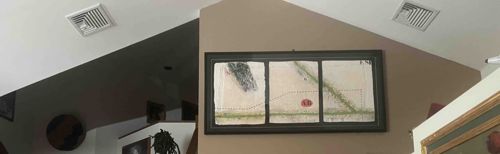
The item is a framed multi-panel artwork, specifically a triptych, presented in a dark, possibly black or very dark brown, frame. This frame appears to be made of wood or a similar rigid material, with a classic, somewhat ornate profile, though details are challenging to discern fully from the image. The artwork itself consists of three rectangular panels, likely canvas or paper, arranged horizontally within the single frame. Each panel features abstract or mixed-media elements. The left panel shows prominent dark, possibly charcoal or ink, marks against a lighter background, along with subtle green or light-colored horizontal lines. The central and right panels depict a muted, light-toned ground, possibly beige or off-white, with significant green, somewhat wispy or feathered strokes that suggest grass or organic growth. Both the central and right panels also exhibit faint dashed red lines, possibly indicating outlines or mapping, and the central panel features a distinct red, circular or oval shape with additional markings (possibly 'AD' or 'A.D.'). The overall aesthetic leans towards contemporary or abstract expressionism. The piece is displayed high on a wall with a sloped ceiling, suggesting it is a significant focal point in the room. There are no obvious signs of overt damage from the visible distance, such as cracks in the frame or tears in the artwork, though the overall condition implies a matured piece, possibly exhibiting a slight patina consistent with age. Maker's marks or signatures are not discernible from the image provided. The craftsmanship appears to be of reasonable quality, given the clean lines of the frame and the seemingly deliberate composition of the artwork.
AI Appraisal Report
Upon visual examination of the provided image, this Abstract Triptych Wall Art presents as a contemporary or abstract expressionist piece. The condition appears to be good for its age, with no obvious signs of overt damage like frame cracks or tears in the artwork. However, a slight patina consistent with age is implied, which is common and often adds character. Authenticity cannot be definitively verified from images alone; maker's marks or signatures are not discernible. The circular red mark with 'AD' or 'A.D.' on the central panel is intriguing but insufficient for attribution without further context.
In terms of market conditions, abstract triptychs with subtle multi-media elements like this one typically appeal to a broad range of buyers seeking modern decor. While not a high-demand, rare, or collectible item in the absence of a known artist or significant provenance, the aesthetic quality and presumed good condition make it desirable. Comparables for unsigned, decorative abstract art of this size and complexity often fall within a modest range. The frame's classic profile adds to its decorative appeal, enhancing its perceived value.
Factors significantly impacting value are primarily the lack of artist attribution and provenance. Without these, its value remains in the decorative art market rather than the fine art market. For full authentication and a more precise valuation, an in-person examination is crucial to assess surface condition, media used, and look for hidden signatures or marks. Provenance documentation (e.g., bills of sale, exhibition history) and potentially scientific testing of materials would be necessary to establish authenticity and potentially elevate its market standing.