AI estimate as of September 21, 2025 · verify with a professional before acting
AI-Generated · Verify before acting
Everything on this page is generated by AI for informational purposes only. AI can make mistakes — the AI may misidentify items or misattribute them (artist, maker, brand, designer, origin, era). This is not an official valuation and should not be used for insurance, sale, tax, estate, legal, or lending purposes — or any decision requiring a certified appraisal. It is not an authoritative claim about any person, brand, or rights holder — do not share or rely on it as a factual statement about a third party. Always consult qualified professionals before making financial decisions.
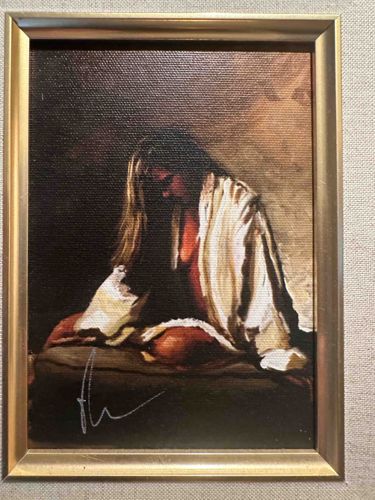
This item is a framed canvas print, depicting a figure, likely female, reclining or seated with a sense of introspection or melancholy. The dominant colors in the print are earthy tones, featuring a dark brown or black background that transitions into warmer browns and oranges, suggesting an interior or dimly lit setting. The figure is shown with long, flowing brown hair covering part of her face, and is draped in a loose-fitting, off-white or cream-colored garment that contrasts sharply with red or reddish-brown attire underneath. The textural quality of the canvas is clearly visible, indicating it is likely a canvas print rather than an original painting, possibly a giclée or similar photographic reproduction on canvas. The print is housed in a simple, thin gold-colored metallic frame, which appears to be made of aluminum or a similar lightweight metal. The frame corners are mitered, and the finish is a satin or brushed gold, showing minimal wear. The print itself exhibits no visible damage, tears, or significant discoloration. A prominent white stylized signature, possibly 'T.H.' or similar, is located in the lower left quadrant of the image. The overall style suggests a contemporary or modern realist approach, with a strong focus on light and shadow, reminiscent of chiaroscuro techniques. The piece aims to evoke emotion through its subject and dramatic lighting. The craftsmanship of the print appears high quality, with good color saturation and detail retention, while the frame is functional and complements the artwork without distracting from it. The item presents as a decorative art object, likely produced in the late 20th or early 21st century.
AI Appraisal Report
I have examined the provided description of this framed canvas print, 'Reclining Figure'. Based on my visual assessment, the print appears to be in excellent condition, with no visible damage, tears, or significant discoloration. The canvas texture is clearly evident, reinforcing its identity as a print rather than an original painting, likely a giclée. The frame is a simple, thin gold-colored metallic type, also in good condition, complementing the artwork without being overly ornate. The visible signature 'T.H.' is a stylized element within the print itself and not an original artist's signature on a painting.
Market conditions for decorative canvas prints like this are generally modest. While the aesthetic quality, dramatic lighting, and emotional subject matter are appealing, the item's valuation is fundamentally impacted by its nature as a reproduction. It lacks the uniqueness and intrinsic value of an original artwork, and without further information, the artist's notoriety cannot be established. Comparables in the market for similar high-quality decorative canvas prints, especially those without established artist provenance or limited edition status, typically range from $50 to $200, depending on size, quality, and framing.
Demand for such decorative pieces is steady but not driven by rarity; these types of prints are widely available. The value is primarily tied to its decorative appeal and condition. The excellent condition and tasteful framing contribute positively to its marketability.
It is crucial to note the limitations of authenticity verification from images alone. Without physical inspection, I cannot confirm the exact printing method (e.g., giclée vs. standard canvas print), the quality of the canvas and inks used, or the precise nature of the signature. Full authentication of original authorship (if it were claimed to be an original artwork) would require in-person examination by a qualified art expert, detailed provenance documentation, and potentially scientific testing of the pigment layers. Given it is a canvas print, the primary authentication concern would be confirming it is not misrepresented as an original, which the description already clarifies.