AI estimate as of October 12, 2025 · verify with a professional before acting
AI-Generated · Verify before acting
Everything on this page is generated by AI for informational purposes only. AI can make mistakes — the AI may misidentify items or misattribute them (artist, maker, brand, designer, origin, era). This is not an official valuation and should not be used for insurance, sale, tax, estate, legal, or lending purposes — or any decision requiring a certified appraisal. It is not an authoritative claim about any person, brand, or rights holder — do not share or rely on it as a factual statement about a third party. Always consult qualified professionals before making financial decisions.
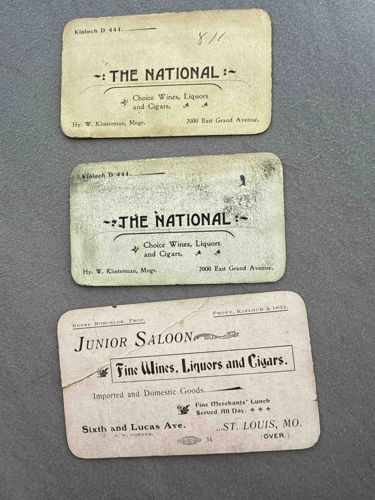
This collection consists of three vintage business cards, likely dating from the late 19th or early 20th century, advertising establishments specializing in wines, liquors, and cigars. Two of the cards are identical in design and advertise 'THE NATIONAL' saloon, managed by Hy. W. Klosterman, located at 2000 East Grand Avenue. These two cards feature a simple, classic typeface for 'THE NATIONAL' with decorative flourishes, and list 'Choice Wines, Liquors and Cigars.' They are rectangular with rounded corners, printed on what appears to be light cream or off-white cardstock. Visible condition issues include significant discoloration, foxing, and some dark scuff marks or minor abrasions, particularly on the second 'THE NATIONAL' card, suggesting considerable age and handling. One of 'THE NATIONAL' cards has a handwritten '811' in its upper right quadrant. The third card, for 'JUNIOR SALOON', owned by Henry Honerkamp, and located at 'Sixth and Lucas Ave., ST. LOUIS, MO.', also advertises 'Fine Wines, Liquors and Cigars.', noting 'Imported and Domestic Goods' and 'Fine Merchants' Lunch Served All Day.' This card exhibits a slightly different aesthetic, with more ornate typography for 'JUNIOR SALOON' and a small illustrative detail (possibly a cherub or similar figure) above the lunch offering. It displays a prominent crease or fold line across the upper left corner and general age-related discoloration. All cards appear to be constructed from a medium-weight paper or light cardstock, indicative of common printing practices of the era. The presence of 'Kinloch D 444' phone numbers on 'THE NATIONAL' cards and 'Phones, Kinloch A 1923' on the 'JUNIOR SALOON' card provides a strong indicator of their age, likely pre-dating rotary dial phones or at least from an era where switchboard operators were common for such numbers. The craftsmanship is typical of commercially printed ephemera of the period, utilitarian yet with attention to readable and appealing design.
AI Appraisal Report
Upon examining the images of this set of three vintage saloon business cards, I have assessed their condition and potential value. The cards, two for 'THE NATIONAL' saloon and one for 'JUNIOR SALOON' in St. Louis, appear authentic to the late 19th or early 20th century. The typography, listed offerings of wines, liquors, and cigars, and the presence of early Kinloch phone numbers are all consistent with ephemera from this era. The condition is fair to poor, with significant, widespread discoloration (foxing), scuffs, creases, and handwritten marks, all of which detract from the value. While this patina confirms their age, the damage is extensive. The market for vintage business cards, or ephemera, is niche but active. Cards related to saloons, especially from well-known cities like St. Louis, hold interest for collectors of local history, breweriana, and general Americana. The rarity is moderate; while saloon cards from this period are not exceptionally common, they are not impossibly rare either. The duplication of 'THE NATIONAL' card slightly diminishes the set's overall uniqueness. The primary value drivers are the specific historical context and graphic appeal. The significant condition issues are the main limiting factor on value. A comparable single card in better condition might sell for $20-$30, making this set of three in lesser condition valued accordingly. A full authentication would require in-person examination to assess the paper stock, printing method (e.g., letterpress), and ink composition. Without physical inspection, I cannot definitively rule out the possibility of modern reproductions, although they appear genuine based on the signs of natural aging.