These notes were written by the person who submitted this item. Appraiser.AI has not verified them, and the AI's identification and estimate may rely on them.
AI Estimated Value
Not an official valuation
$30-50
AI estimate as of October 5, 2025 · verify with a professional before acting
AI-Generated · Verify before acting
Everything on this page is generated by AI for informational purposes only. AI can make mistakes — the AI may misidentify items or misattribute them (artist, maker, brand, designer, origin, era). This is not an official valuation and should not be used for insurance, sale, tax, estate, legal, or lending purposes — or any decision requiring a certified appraisal. It is not an authoritative claim about any person, brand, or rights holder — do not share or rely on it as a factual statement about a third party. Always consult qualified professionals before making financial decisions.
This analysis also relies on unverified notes provided by the user, which may be incomplete or inaccurate and could affect the result.
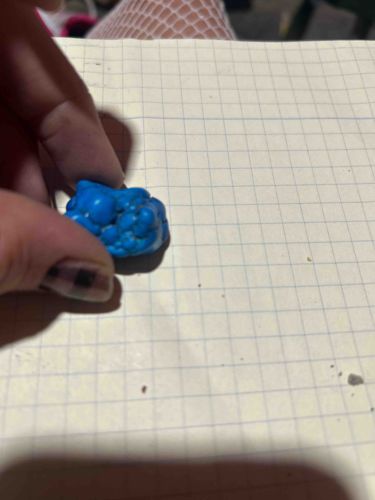
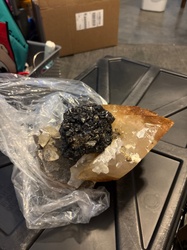
The item is an unpolished, raw specimen of what appears to be turquoise, held between a thumb and forefinger. It is a small, irregularly shaped chunk, characterized by its vibrant, opaque robin's egg blue color. The surface is uneven and textured, displaying a botryoidal or globular habit, which means it is composed of numerous small, rounded masses resembling a bunch of grapes. Some areas show a lighter, almost white or pale blue coloration within the crevices and on some of the rounded nodules, suggesting natural matrix inclusions or variations in mineral composition or weathering. The size is difficult to ascertain precisely without a scale, but it appears to be approximately 1-2 cm in its largest dimension, fitting comfortably between two fingers. There are no visible cut or polished faces, nor any discernible carving or treatment. The stone exhibits a dull to sub-vitreous luster typical of rough turquoise. No specific maker's marks, signatures, or stamps are visible. The item appears to be a natural mineral specimen, likely a raw gemstone suitable for lapidary work, jewelry making, or as a collector's piece. The quality indicators point to its natural, unaltered state, with the bright blue color being a desirable characteristic. The presence of subtle white inclusions adds to its natural aesthetic without appearing to be a significant condition issue or damage.
AI Appraisal Report
Upon examining the provided image, I observe an unpolished, raw specimen of what appears to be natural turquoise. The vibrant robin's egg blue color is highly desirable, and the botryoidal habit is characteristic of natural turquoise. The surface texture and unevenness indicate its raw, unaltered state, consistent with a natural mineral specimen. The subtle lighter inclusions are likely matrix material or natural variations, which are typical and do not detract significantly from its appeal as a specimen. The size, estimated at 1-2 cm, is modest.
Authenticity, based solely on visual inspection of the image, appears strong for natural turquoise. The color, luster, and habit are all consistent. However, without in-person examination, it is impossible to definitively rule out simulants or treated material. Many materials are dyed or reconstituted to imitate turquoise. A physical examination would allow for hardness testing, specific gravity measurement, and a more detailed surface analysis to confirm its authenticity. For full authentication, spectroscopic analysis (e.g., Raman or FTIR) would be conclusive.
Market conditions for small, raw turquoise specimens are relatively stable. While desirable, unpolished pieces of this size command modest prices, usually purchased by collectors, lapidary enthusiasts, or for educational purposes. Comparables include small rough turquoise nuggets from established mines (e.g., Kingman, Sleeping Beauty, although without provenance, specific mine origin cannot be confirmed). Demand is consistent for natural, attractive specimens. The primary factor impacting value is its natural color and botryoidal texture; its unpolished state contributes to its appeal as a raw mineral specimen.
Considering its size, raw state, and visual characteristics, and acknowledging the limitations of image-only appraisal, I would place its approximate retail appraisal value in the range of $30-50. This accounts for its appealing color and natural formation, balanced against its small size and raw condition without specific provenance.